
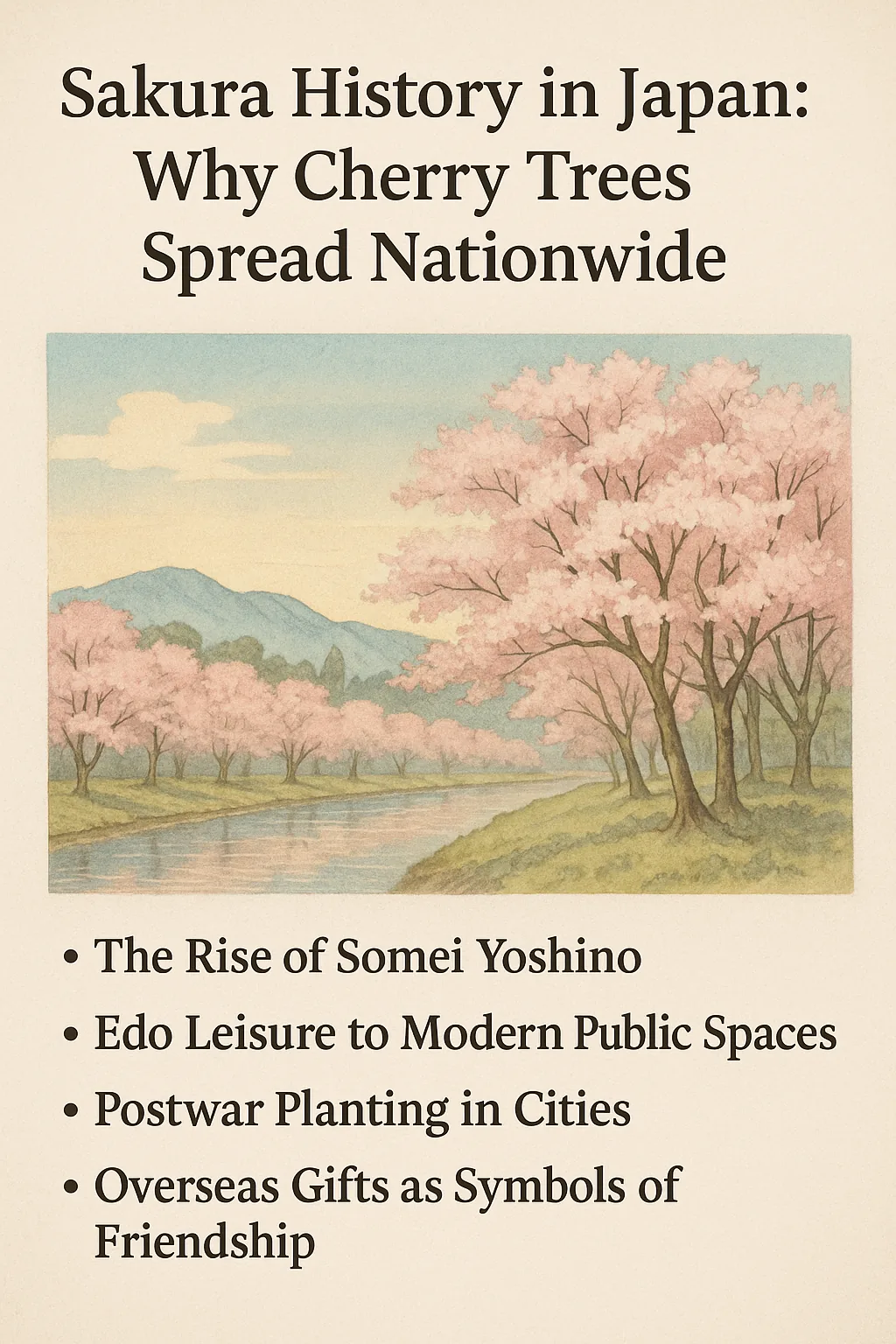

Sakura history in Japan 1po
Every spring, Japan seems to turn into a single shared canvas of pale pink. You find cherry trees along rivers, inside schoolyards, beside train tracks, in neighborhood parks, and even in the quiet corners of office districts. For visitors, this can feel like a beautiful mystery: why do cherry blossoms appear everywhere, in almost every town? The answer is not just “because they’re pretty.” The sakura history in Japan is a story of ecology, urban design, memory, and modern identity—plus a second story that extends beyond Japan’s borders, where cherry trees became living symbols of friendship.
Start here: Cherry blossom in Japan (Sakura): best time & places
This article explores how Japan became a nation of cherry trees, why one cultivar came to dominate urban landscapes, and how sakura traveled abroad as gifts that still shape international cultural ties today.
Sakura Bloom Status by Region (2026)
| Region | Early bloom early types |
Main bloom Somei Yoshino |
Late bloom late types |
|---|---|---|---|
| Kyushu Fukuoka area |
N 🍃 | N 🌱 Mar 21 | – ⏳ Mar 28 |
| Kansai Kyoto / Osaka |
N 🍃 | N 🌱 Mar 25 | – ⏳ Apr 1 |
| Chubu Nagoya area |
N 🍃 | N 🌱 Mar 20 | – ⏳ Mar 27 |
| Kanto Tokyo / Yokohama |
E 🍃 | E 🌱 Mar 21 | – ⏳ Mar 28 |
| Tohoku Sendai area |
E ⏳ Mar 29 | E 🌱 Apr 5 | – ⏳ Apr 12 |
| Hokkaido Sapporo area |
– ⏳ Apr 18 | E ⏳ Apr 25 | – ⏳ May 2 |
Compare to normal year
E = earlier than a normal year,
N = around normal,
L = later than a normal year,
– = not applicable / no clear pattern
Current status
🌱 = buds,
🌸 = blooming (partial),
🌺 = full bloom,
🍃 = past-peak / leafing,
⏳ = not started / pre-season
When the icon is 🌱 or ⏳
Date = forecast first-bloom day for that sakura wave in 2026.
Before the pink wave: mountain sakura and older spring views
Long before urban parks and riverside promenades, spring beauty in Japan was tied to wilder landscapes. Early poetic traditions celebrated blossoms in nature, where different local varieties bloomed at slightly different times. These trees were part of forests and hills, woven into seasonal life rather than staged for crowds.
Over time, as cities expanded and leisure culture grew, the desire to bring seasonal beauty into daily life increased. Gardens, temple grounds, and later public spaces became settings where spring could be “invited” closer to people. The popularity of organized viewing and the gradual shift of sakura from distant hills to accessible places laid the groundwork for what came next: a more standardized, more dramatic experience of spring.
Sakura history in Japan: the rise of Somei Yoshino
If you’ve visited Japan during peak season, you’ve probably seen the same style of blossom repeating across cities. This is largely due to Somei Yoshino, a cultivar that became a near-universal choice for urban planting.
Why did it spread so effectively? First, it creates a strong visual impact. Its blossoms often appear before the leaves fully develop, producing a soft, unified pink canopy that reads clearly even from a distance. Second, it blooms in a relatively synchronized way, which makes it perfect for announcing “the season has arrived” in a single, unmistakable gesture.
For city planners and community organizers, this offered something powerful: a reliable annual moment that draws people outside and turns public spaces into shared stages. Somei Yoshino didn’t just suit taste—it suited the logistics of modern life.
From Edo leisure to modern public spaces
Edo refers to Tokyo’s former name and the historical era roughly spanning 1603–1868, when the city grew into one of the world’s largest urban centers and seasonal leisure culture flourished. This period helped shape the early roots of organized spring enjoyment in city life.
Urban sakura culture did not appear overnight. As public parks expanded, and as riverside areas were developed into safer, more walkable environments, planting cherry trees became an easy way to convert “infrastructure” into “experience.”
A walkway under cherry trees encourages slow walking, picnics, and shared gatherings. A schoolyard with sakura becomes an emotional landmark for graduation and entrance ceremonies. A local park becomes a community memory bank.
This is one reason cherry trees feel “everywhere” today. They were not planted only for tourists. They were planted because they work: they beautify space, create seasonal identity, and strengthen the emotional bond between residents and their towns.
The postwar landscape and the idea of rebuilding beauty
As Japan rebuilt and reorganized many urban areas in the 20th century, planting trees in public spaces became part of shaping healthier and more attractive city life. Cherry trees, already culturally beloved, offered a ready-made symbol of renewal and hope.
This is why you’ll often see substantial rows of sakura in places that function as shared civic spaces—parks, riversides, and school grounds in particular. Even when local histories differ, the shared pattern is consistent: sakura became a dependable way to mark the calendar and soften urban environments.
Why sakura stuck: the emotional technology of spring
Sakura compresses time. The bloom is brief, the beauty feels urgent, and the falling petals form a visually gentle ending. This tempo turns ordinary places into once-a-year meaningful spaces without needing formal rituals.
In that sense, sakura acts like a kind of “emotional technology.” It helps people notice change, celebrate transitions, and accept impermanence without having to name those concepts explicitly—one reason the trees are tied to life milestones such as school graduations, job transfers, and new beginnings.
Sakura abroad: when cherry trees became cultural bridges
One of the most moving chapters of sakura history is how cherry trees were shared internationally as symbols of friendship. The most famous example is the early 20th-century gift of cherry trees to Washington, D.C., an act that planted a living cultural relationship into another country’s landscape.
What makes this story resonate is the medium itself. A cherry tree gift is not a one-time gesture; it’s a recurring reminder. The blossoms return each year, quietly renewing the meaning of friendship across borders.
How to read sakura in Japan today
When you walk through Japan during cherry blossom season, you’re seeing more than a pretty view. You’re seeing layered decisions: aesthetic preference meeting urban practicality, community life meeting seasonal ritual, and personal memory meeting public space.
- Look at the setting. Schoolyards, riversides, and civic parks often reveal why planting decisions were made.
- Notice the rhythm of the crowd. Festival-like spaces and quiet neighborhoods reflect different styles of hanami.
- Spot variety when you can. Temples, older gardens, and rural areas may feature different cultivars and timings.
- Treat the petals as the second act. The falling phase is part of the aesthetic narrative, not an afterthought.
Travel Tips
- If big-city parks feel crowded, try riverside paths, residential neighborhoods, and campus-adjacent streets.
- A culture-first micro-route: quiet morning walk → local café → short riverside hanami → early departure.
- Pair this reading with your seasonal planning hubs: Cherry Blossom in Japan, Seasonal Events in Japan, Japanese Calendar.
Trivia
- Even without knowing the cultivar name, you’ve likely seen Somei Yoshino’s signature look: pale blossoms that briefly transform entire streets before leaves fully emerge.
- In many towns, the most meaningful viewing spots are community-kept sites—small shrines, schools, and neighborhood riversides that reflect local pride.
FAQ
Why are cherry trees planted so widely across Japan?
Because they combine beauty with function: they soften urban spaces, create seasonal identity, and serve as emotional landmarks for communities.
Is one type of cherry tree especially common?
Yes. In many urban and suburban areas, Somei Yoshino is widely planted due to its strong visual impact and relatively synchronized bloom.
Why did Japan send cherry trees overseas?
Cherry trees became a peaceful cultural symbol that could represent friendship and mutual appreciation through a shared seasonal experience.