

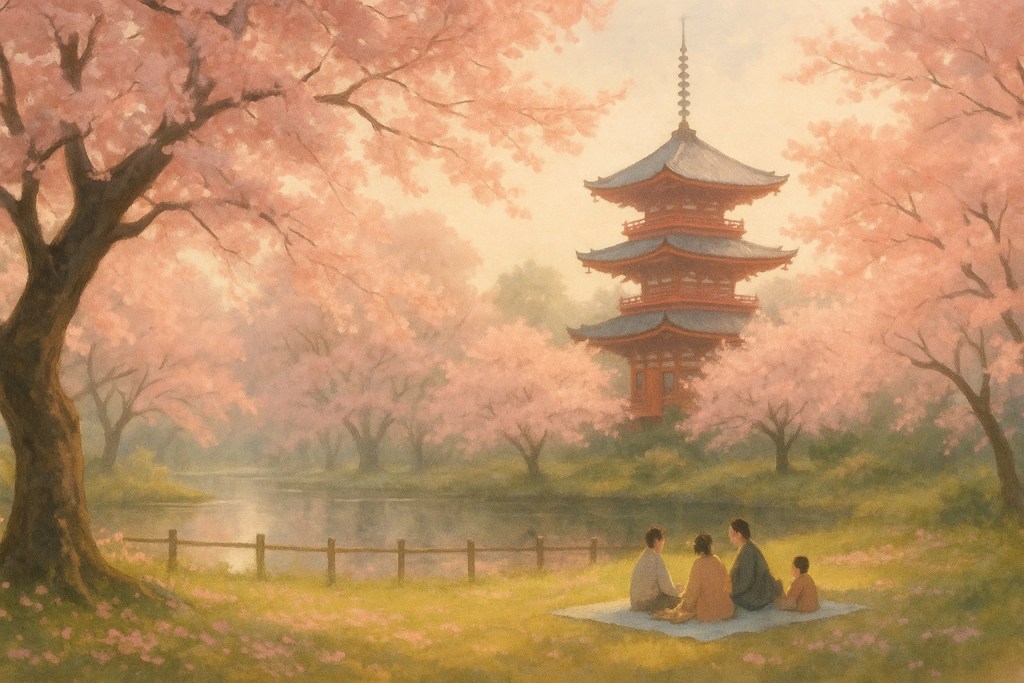
Cherry blossom in Japan
Note: This page uses Somei Yoshino (ソメイヨシノ)—Japan’s most common “main wave” cherry—as the baseline for timing by region. Bloom dates vary year to year, and other varieties can peak earlier or later. If you’d like to learn how to spot different sakura types (and plan by bloom “waves”), see our hub: Cherry Blossom Varieties in Japan: How to Spot Sakura Types .
Cherry blossom in Japan (sakura) is one of the most famous reasons to visit the country in spring. This guide explains what the blossoms mean in Japanese culture and how to think about timing by region. It offers general seasonal guidance, not a live forecast. This way, you can plan your trip with realistic expectations and a relaxed mindset.
For a quick overview of how cherry blossom season fits into the rest of the year, see our Japanese Calendar.
Quick summary
- Typical best window (normal year): late March to early April (Tokyo/Kyoto/Osaka), then mid–late April (Tohoku), late April to early May (Hokkaido).
- Plan smarter: think in ranges (1–2 weeks) instead of one perfect day.
- Check before you go: before you visit, check each spot’s official page for the latest updates.
Sakura Bloom Status by Region (2026)
| Region | Early bloom early types |
Main bloom Somei Yoshino |
Late bloom late types |
|---|---|---|---|
| Kyushu Fukuoka area |
N 🍃 | N 🌱 Mar 21 | – ⏳ Mar 28 |
| Kansai Kyoto / Osaka |
N 🍃 | N 🌱 Mar 25 | – ⏳ Apr 1 |
| Chubu Nagoya area |
N 🍃 | N 🌱 Mar 20 | – ⏳ Mar 27 |
| Kanto Tokyo / Yokohama |
E 🍃 | E 🌱 Mar 21 | – ⏳ Mar 28 |
| Tohoku Sendai area |
E ⏳ Mar 29 | E 🌱 Apr 5 | – ⏳ Apr 12 |
| Hokkaido Sapporo area |
– ⏳ Apr 18 | E ⏳ Apr 25 | – ⏳ May 2 |
Compare to normal year
E = earlier than a normal year,
N = around normal,
L = later than a normal year,
– = not applicable / no clear pattern
Current status
🌱 = buds,
🌸 = blooming (partial),
🌺 = full bloom,
🍃 = past-peak / leafing,
⏳ = not started / pre-season
When the icon is 🌱 or ⏳
Date = forecast first-bloom day for that sakura wave in 2026.
Why cherry blossom in Japan (sakura) matters
Cherry blossoms, or sakura, are much more than pretty flowers in Japan. They mark the arrival of spring, the end and beginning of school and business years, and a moment to pause and appreciate the passing of time.
In traditional poems and paintings, sakura often symbolize the beauty of life that appears suddenly and disappears quickly. This idea of fragile, fleeting beauty is sometimes called the “aesthetics of things that fall or fade.” As a result, cherry blossom in Japan often feels emotional, nostalgic and a little bittersweet.
Today, city parks, riversides, castle grounds and even quiet neighborhood streets become temporary picnic spaces. Families, friends, colleagues and couples sit on picnic sheets, share food and drinks, and watch the blossoms together. In particular, even if you do not join a big picnic, simply walking through a sakura-lined street in soft spring light can feel like stepping into another world.
When is cherry blossom in Japan at its best?
Cherry blossom season does not start everywhere at once. It usually begins in the south and along the Pacific coast, then moves north and into the mountains over several weeks.
The exact timing changes every year with the weather, so it is helpful to think in terms of normal-year ranges rather than exact dates. Therefore, it is wise to use these ranges as a guide and, before you visit, check each spot’s official page for the latest updates (hours, access, ticketing, event dates, and crowd notes).
Tokyo and the Kanto region
In and around Tokyo, cherry blossoms usually begin to open in late March, with many spots reaching their best viewing in late March to early April. In some years, early varieties or trees in sunny spots may bloom a little earlier.
Major viewing places include city parks, rivers, temple and shrine grounds, and quieter residential neighborhoods. Because Tokyo is densely populated, crowds can be intense at famous spots on weekend afternoons. However, early mornings or weekday evenings often feel more relaxed and more local.
Kyoto, Osaka and the Kansai region
In Kyoto, Osaka and the wider Kansai area, cherry blossom season typically arrives slightly after Tokyo, often from late March to early April, with best views overlapping the first days of April.
Historic sites such as temples, shrines and old streets can become very busy. Even so, the atmosphere can be magical in the early morning, when the streets are quieter and soft light touches the old wooden buildings and stone paths. In Osaka and other modern cities, riversides and parks offer a different, more urban style of hanami.
Northern Japan: Tohoku and Hokkaido
In northern regions, cherry blossom season usually comes later. Many areas in Tohoku see blossoms from mid to late April, and Hokkaido can bloom from late April into early May.
This northward wave means that, in some years, it is possible to travel from Tokyo or Kyoto and then continue north to “chase” the blossoms as they open. As a result, you can enjoy cherry blossom in Japan over a longer period by changing regions rather than dates.
Rough timing by region (normal year)
The table below shows rough normal-year timing for cherry blossom in Japan by region. Each column stands for one month from January (1) to May (5), and each column is divided into three small boxes: early, mid and late in that order. Sakura-colored boxes show when blossoms are usually at their best.
| Region | Main examples | Typical timing (normal year) |
|---|---|---|
| Okinawa | Naha area, Nago, Yaedake |
Late January to February (earlier season, different varieties)
|
| Kyushu & Shikoku | Fukuoka, Kumamoto, Nagasaki, Matsuyama |
Late March to early April
|
| Tokyo & Kanto | Tokyo, Yokohama, Kamakura |
Late March to early April
|
| Kyoto, Osaka & Kansai | Kyoto, Osaka, Nara, Kobe |
Late March to early April (often a few days after Tokyo)
|
| Central inland (Nagano etc.) | Nagano, Yamanashi inland, mountain towns |
Early to mid April
|
| Tohoku (Fukushima, Aomori etc.) | Fukushima, Miyagi, Aomori |
Mid to late April
|
| Hokkaido | Sapporo, Hakodate, Matsumae |
Late April to early May
|
In the small grid above, each column shows one month from January (1) to May (5). Within each month, the three boxes represent early, mid and late parts of the month. Sakura-colored boxes indicate periods when cherry blossom in Japan is typically at its best in a normal year.
In warm years some areas can be up to about two weeks earlier than these ranges, and in cold years a little later. When you plan your cherry blossom in Japan trip, use these ranges as a flexible guide rather than a fixed promise. In addition, always check the latest official forecast before you travel.
Cultural cherry blossom in Japan experiences: where blossoms meet history
If you would like to connect cherry blossom in Japan with places that have a strong cultural story, the following examples can be a helpful starting point. This is not a complete list, but a small selection of spots where history, belief and everyday life are closely woven into the sakura scenery.
Example cultural cherry blossom in Japan spots
Mt. Yoshino, Nara
Nara · Sacred mountain and World Heritage
A sacred mountain for Shugendo practice and part of a UNESCO World Heritage Site, Mt. Yoshino has been planted with cherry trees for centuries. Thousands of blossoms along the slopes have inspired classical poetry, pilgrimage routes and spring celebrations.
CULTURE: Yoshino has long been a place where religion, poetry and nature meet. Pilgrims walked these paths to train in the mountains, and cherry trees were offered to the deities. Seeing the slopes layered with blossoms is like seeing a physical map of spiritual and literary history.
Ueno Park, Tokyo
Tokyo · Classic city hanami park
One of Japan’s oldest public parks and a classic city hanami spot, Ueno Park combines museums, a zoo, temples and long avenues of cherry trees. During the main season the park becomes a lively festival space with lanterns, food stalls and picnics beneath the blossoms.
CULTURE: Ueno was once the grounds of a powerful temple that watched over Edo (old Tokyo). It later became a symbol of modern public space in the Meiji era. Hanami here reflects how city life, popular entertainment and art all came together in the new capital.
Hirosaki Park and Hirosaki Castle, Aomori
Aomori · Northern castle town and park
A former samurai castle town where stone walls, moats and historic turrets are wrapped in blossom. Lantern-lit paths, petal-covered moats and views of distant mountains create a deeply nostalgic atmosphere.
CULTURE: Hirosaki’s sakura festival grew from a castle town’s pride and care for its trees. The contrast between heavy stone fortifications and fragile petals embodies a northern samurai aesthetic: strong structures softened by a short, brilliant spring.
Takato Castle Ruins Park, Nagano
Nagano · Mountain castle ruins and blossoms
The remains of a mountain castle transformed into a sea of pale pink blossoms. The contrast between rugged fortifications and delicate flowers reflects Japan’s long history of seeing beauty in impermanence.
CULTURE: Takato is famous for a local variety of cherry tree that gives the hills a distinctive, soft color. The idea that a former battlefield can become a beloved flower-viewing hill captures a very Japanese transformation: from war and power to seasonal beauty shared by families and children.
Maruyama Park and the Gion area, Kyoto
Kyoto · Night-sakura and historic streets
A famous weeping cherry tree, teahouses and nearby shrines create a classic Kyoto night-sakura scene. Evening illuminations, traditional streets and the presence of local life make it feel like a living theatre of spring.
CULTURE: Maruyama Park sits beside Yasaka Shrine and the old entertainment district of Gion. For generations, merchants, artists and performers gathered here in spring, blurring the line between festival, everyday life and staged beauty. Night-time hanami under the big weeping cherry carries this mood into the present.
The Philosopher’s Path, Kyoto
Kyoto · Canal walk between temples
A quiet stone walkway along a canal lined with cherry trees. As you stroll between temples, shrines, small cafés and traditional homes, it is easy to understand why this path is associated with reflection and gentle, everyday beauty.
CULTURE: The path is named after a modern philosopher who is said to have walked this route while thinking. Today it represents a softer side of Kyoto: not grand ceremonies, but the everyday act of walking, noticing water, trees and small details as a kind of moving meditation.
Nijo Castle, Kyoto
Kyoto · World Heritage castle garden
A World Heritage castle where cherry trees bloom around historic gates and gardens. Light-up events and seasonal displays connect modern visitors with the political and cultural crossroads of the Edo period.
CULTURE: Nijo Castle was the Kyoto residence of the Tokugawa shoguns and the stage for major political moments, including the formal end of shogunal rule. Walking through flowering gardens here means seeing spring layered over the memory of power, negotiation and historical change.
Chidorigafuchi Moat, Tokyo
Tokyo · Imperial moat and city skyline
Cherry trees arching over the moat beside the Imperial Palace create a powerful combination of nature and modern capital city. Walking the riverside path or viewing the blossoms from a boat offers a calm counterpoint to Tokyo’s busy streets.
CULTURE: The moat is a remnant of Edo Castle, now surrounding the Imperial Palace. Sakura here are a reminder that Tokyo, for all its glass and neon, grew out of a castle town whose defensive walls are now places for evening walks, date nights and quiet moments on the water.
Shinjuku Gyoen National Garden, Tokyo
Tokyo · National garden in the city center
A large, carefully designed garden that feels like an oasis in the middle of the city. Different varieties of cherry trees bloom here across several weeks, from early-blooming types to later, fluffy double blossoms. This makes it an excellent place to experience the gradual progression of spring.
CULTURE: Shinjuku Gyoen began as a feudal lord’s residence, then became an Imperial garden and later a public park. Its blend of Japanese, French and English-style garden design shows how Japan absorbed foreign influences while keeping a distinctive sense of season and space.
Miharu Takizakura, Fukushima
Fukushima · Famous single weeping cherry tree
A single, ancient weeping cherry tree whose branches fall like a waterfall of petals. Protected as a natural monument, it shows how one tree alone can become the center of a community’s spring memories.
CULTURE: The tree is counted among the most famous cherry trees in Japan and has been cherished for generations by the people of Miharu. Visiting feels less like going to a “spot” and more like being introduced to a local guardian whose life spans many human lifetimes.
You do not need to visit all of these places in one trip. Instead, choose one or two that match your route and let their stories deepen your experience of cherry blossom in Japan. For route ideas, you can also browse The Wa Story’s Japanese cultural itineraries.
How to plan your cherry blossom in Japan trip
When planning for cherry blossom season in Japan, it is tempting to aim for the single perfect day of full bloom. In reality, that is very difficult, even for local residents.
Instead, consider these more relaxed strategies. If you prefer to follow ready-made routes, you can also look at The Wa Story’s Japanese cultural itineraries and adapt them to the spring timing that fits your schedule.
For broader planning advice on timing, base cities, and travel style, visit Plan Your Trip.
Key planning principles
-
Think in ranges, not single dates
Choose a travel window of about one to two weeks that fits your schedule and preferred region, instead of focusing on one exact weekend. This approach gives you more chances to enjoy cherry blossom in Japan, even if the weather shifts. -
Stay flexible within your trip
Once you are in Japan, use local news, tourism information centers and weather apps to adjust your daily plans. For example, you might visit a park earlier than planned if blossoms suddenly open, or switch regions if a warm front arrives. -
Mix sakura with other cultural experiences
Combine blossom viewing with tea experiences, gardens, museums, craft workshops or neighborhood walks. In this way, your trip stays meaningful even if the weather changes or the blossoms arrive early or late. -
Consider less famous spots
Big-name parks fill up quickly, especially in the afternoon. Smaller local parks, riversides and residential areas can offer a gentler, quieter experience. As a result, you may remember simple local moments more warmly than crowded “must-see” places.
By focusing on a well-balanced trip rather than chasing one perfect day, you protect yourself from disappointment and leave room for pleasant surprises.
Ways to enjoy cherry blossom in Japan beyond “perfect full bloom”
One of the most helpful mindset shifts for cherry blossom season in Japan is to appreciate every stage of the blossoms, not only the textbook “full bloom.”
-
Buds and early blossoms
There is a quiet charm in seeing branches dotted with pink buds and a few first flowers. It feels like a promise that spring is on its way. -
Approaching full bloom
When most flowers have opened but some buds remain, trees look full and energetic. The balance of soft pink and fresh green can be especially beautiful. -
Full bloom under blue or cloudy skies
A clear blue sky makes petals glow. However, even on cloudy days, sakura create a dreamy, slightly nostalgic atmosphere. Soft light is also kind for photography. -
Falling petals and “sakura snow”
As petals begin to fall, paths, rivers and ponds can become covered in pink. Many people find this stage even more moving than full bloom, as it reflects the idea that beauty and impermanence are connected.
In short, by noticing these different moments, you are less dependent on hitting a single “peak” day and more open to the season as a whole.
Hanami etiquette: enjoying cherry blossom in Japan with good manners
Because many people gather in the same spaces, a little etiquette helps everyone enjoy cherry blossom in Japan.
Basic hanami manners
-
Do not touch or break branches
Even gentle pulling can damage trees. Avoid shaking branches for photos or videos, even if the petals look beautiful when they fall. -
Mind your picnic space
If you spread a picnic sheet, keep it compact and avoid blocking paths or views. Do not leave items to “reserve” a space for long periods. -
Keep noise at a reasonable level
Laughter is natural, but very loud music or shouting can disturb others. Some parks prohibit speakers or certain activities, so check local rules. -
Take all rubbish home
Trash bins may be limited or removed during busy seasons. Bring bags and carry your waste out with you. -
Respect temples and shrines
Many sakura trees grow on religious grounds. Remember that these are places of worship as well as photo spots.
Overall, following these simple points shows respect for local customs and for the people sharing the space with you. For more everyday manners beyond sakura season, you can also read our guide to Japanese etiquette basics.
If you miss cherry blossom in Japan
Even if your dates do not match the peak of cherry blossom season in Japan, spring offers many other beautiful scenes.
You may find, for example:
- different varieties of cherry blossoms that bloom a bit later,
- wisteria tunnels and gardens,
- azaleas and other vivid flowers,
- fresh green leaves in gardens and mountains.
Every season in Japan has its own mood and celebrations. If you cannot see sakura this time, you may discover something more personal and special for you instead. In addition, you can explore crafts and off-season ideas in our Japanese crafts overview and the practical tips in Plan Your Trip.
Summary: relax and enjoy cherry blossom in Japan
Ultimately, cherry blossom in Japan is famous for a reason, but it does not have to be stressful. Instead of chasing a perfect forecast, focus on understanding what sakura mean in Japanese culture. Then choose a realistic travel window and enjoy whatever stage of the blossoms you encounter.
This page is designed as general cultural and seasonal guidance, not a live forecast. For the latest local information, please check weather or sakura forecast services during your trip. With a flexible plan and an open mind, almost any spring day in Japan can become a memorable hanami day.
If you’d like to understand the cultural meaning behind hanami, shrines, and seasonal customs, explore our Japanese Culture Guides.
For more sample day-by-day routes in different regions, take a look at our Cultural Itineraries.
Related Links:
- Early-bloom sakura in Japan – Where to find early cherry blossoms and how the timing shifts by region.
- Late-bloom sakura in Japan – Later-season blossoms in cooler regions like Tohoku and Hokkaido, with calm travel ideas.
- Japanese cultural itineraries – Sample routes that combine cities, countryside and seasonal experiences, including spring travel.
- Japanese etiquette basics – Everyday manners for trains, temples, shrines and shared public spaces in Japan.
- Japanese crafts overview – Ideas for hands-on cultural experiences that pair well with a spring visit.
- Plan Your Trip – Practical guidance on timing, transportation and trip planning beyond cherry blossom season.
Official Resources:
For the most up-to-date information on weather and cherry blossom timing, please use the following official resources alongside this cultural guide.
- Check before you go: before you visit, check each spot’s official page for the latest updates.
-
Travel Japan – Japan National Tourism Organization
The official travel guide to Japan, with seasonal ideas, regional highlights and practical visitor information. -
Japan Meteorological Agency – Multilingual Weather Information
Official weather forecasts, warnings and maps in multiple languages, useful for planning day-to-day activities. -
Japan Tourism Agency (JTA)
Government agency responsible for tourism policy and statistics, offering background on Japan’s approach to tourism. -
Visiting Japan – Government of Japan
General information on climate, healthcare, money, emergency contacts and other essentials for visitors.
You must be logged in to post a comment.