
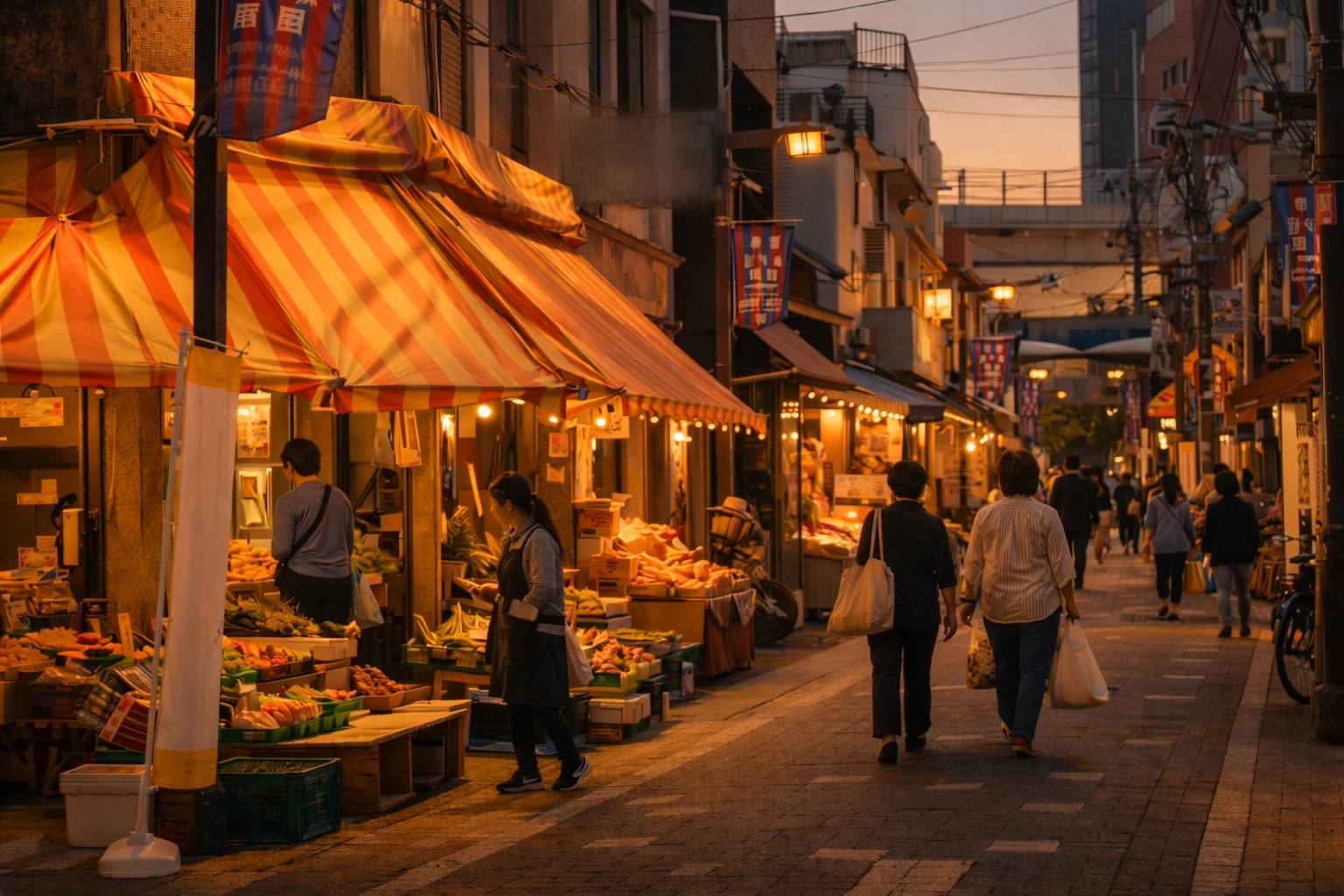

Japanese shopping streets
Japanese shopping streets, or shōtengai (商店街), are far more than places to buy things. They are streets where seasons appear in everyday life, trust is built face to face, and memories of postwar Japan still coexist with today’s cafés and small creative shops. Understanding shōtengai is a key to understanding how people in Japan have lived, shopped, and stayed connected to their communities.
What is a shōtengai?
A shōtengai (商店街) is a shopping street where many small, usually family-run shops line a road that people use in their daily lives. Unlike a modern shopping mall, a shōtengai is typically open to the sky or covered by a simple arcade roof, and it grows along natural walking paths: the road from the station to home, the route to school, or the path to a temple or shrine.
Historically, the roots of shōtengai can be found in monzen-machi (temple and shrine front towns) and shukuba-machi (post towns) in the Edo period. Pilgrims, travellers, and local residents all passed through the same streets, and shops naturally gathered along those routes. In the modern period, as train stations, schools, and city halls appeared, shopping streets formed along these new “everyday routes” and gradually became the centres of neighbourhood life.
In this sense, a shōtengai is not just an economic facility designed from above. It is a cultural street created by footsteps – the accumulated movement of people going to school, going to work, and running small errands every day.
Seasons and daily life in the shōtengai
Before convenience stores and online shopping became common, many households understood the flow of the year through what appeared in their local shōtengai. Seasonal products were not only commercial opportunities; they were clear signals of time for the whole community.
In spring, the wagashi (Japanese sweets) shop filled its window with sakura mochi and later kashiwa-mochi for Children’s Day. In summer, paper fans, uchiwa, wind chimes, and bamboo screens appeared, together with the smell of grilled squid or yakitori at festival stalls. Autumn brought new rice, chestnut sweets, and harvest-themed decorations. In winter, shōtengai hung New Year decorations, sold rice cakes for osechi, and hosted year-end lotteries and bargain sales.
These seasonal goods and decorations meant that a shōtengai was more than a place to buy things. It was a place where residents received the seasons through sight, smell, taste, and sound. Even without checking a calendar, one could walk the street and feel, “Ah, the New Year is coming,” or “It is almost Obon.”
Seasonal events also used the shōtengai as their main stage. Tanabata decorations, summer festival lanterns, and year-end lucky draws were often organised by the shopping street association. In Japanese terms, the shōtengai connects hare (special, festival time) and ke (ordinary, everyday time): festivals and everyday shopping happen on the very same stones of the street.
Trust, face-to-face commerce, and community
A traditional shōtengai is also a place where the Japanese idea of “face-to-face trust” appears clearly. Many shops are run by families, and shopkeepers know their regular customers by face and often by name. A greeting at the entrance, a short chat about the weather or the children, and small extra pieces slipped into the bag were all part of the daily rhythm.
In some neighbourhoods, it was once common for families to buy on credit at their regular shops and pay later. This practice, called tsuke, relied on mutual trust; it only worked because the shopkeeper and customer expected to see each other again and again. Here, economic transactions were woven together with long-term human relationships.
This atmosphere connects to the well-known merchant philosophy of sanpō yoshi – “good for the seller, good for the buyer, and good for society.” In a shōtengai, this idea is not a slogan on a poster but something that becomes visible in the small gestures of everyday business.
Children and everyday learning in the street
For many people in Japan, especially in the postwar decades, the shōtengai was also a place of childhood learning. On the way home from school, children stopped at the takoyaki stall or the small toy shop. They learned how to handle coins, how to greet adults, and how to wait their turn in line.
Shopkeepers often acted as another layer of community care. They might gently scold children who behaved badly, encourage them during exam season, or quietly keep an eye on them when parents were busy. During summer festivals, children helped carry portable shrines, sold drinks at temporary stalls, or performed simple dances, gaining confidence in front of neighbours.
In this way, shōtengai functioned as a “street classroom” where children learned social rules, rhythms, and relationships that could not be fully taught at home or in school.
Sounds, smells, and colours: everyday cultural heritage
Shōtengai are also rich in sensory memories. The smell of dashi stock from a noodle shop, the sound of oil frying croquettes, the rhythmic call of the greengrocer, and the bright colours of seasonal sweets and plastic toys create a unique atmosphere that is difficult to reproduce in modern malls.
Late afternoon sunlight, filtered through an arcade roof, creates a particular kind of shadow. Bicycles ring their bells softly as they weave through shoppers. Old hand-painted signs and slightly faded shop curtains mix with new café logos and craft beer bars. All of these layers form a kind of “time collage”, where Showa-era memories and Reiwa-era lifestyles overlap in the same narrow street.
For many residents, these sights, sounds, and smells are part of their personal history. Even if they do not visit their local shōtengai as often today, the memory of the street remains a powerful symbol of “home.”
Today: how shōtengai are changing
Today, the role of shōtengai in daily life has changed significantly. Supermarkets, convenience stores, suburban shopping centres, and online shopping have taken over many of the practical functions that traditional shopping streets once provided. In many districts, shops have closed because of ageing owners, changing lifestyles, and the shift to car-based shopping in the suburbs.
At the same time, shōtengai have not simply “disappeared.” They are in a period of transition. Some shopping streets have become quieter, but others are experimenting with new forms of value. Young shop owners open bakeries, coffee stands, or craft shops in old spaces. Some areas use retro Showa-style signs and interiors as a deliberate attraction for visitors, turning nostalgia into a resource. In a few districts, empty shops have been converted into small co-working spaces, community cafés, or social enterprises.
National and local governments, as well as shopping street associations, have also tried various support programs to revitalise these neighbourhoods, from event campaigns to subsidies for renovation and new businesses. Results differ from place to place, but the core idea is the same: to help shōtengai continue as lively community streets, even if their mix of shops and services looks very different from the past.
For visitors today, this means that experiencing a shōtengai is not only about “old Japan.” It is also a chance to see how communities are trying to balance tradition and change in real time. A single walk down a shopping street may reveal both closed shutters and newly opened cafés — a visual record of Japan’s demographic and cultural shifts.
Trivia: shōtengai facts and small stories
- The “golden age” of many shōtengai was roughly from the late 1950s to the mid-1960s, when economic growth, small family-run shops, and daily foot traffic all peaked.
- Some of the longest shōtengai in Japan stretch for several kilometres, connecting multiple stations and neighbourhoods in one continuous line of shops.
- In some cities, traditional shopping streets are now used as disaster-ready zones, with reinforced buildings and stocked food that can support local residents in emergencies.
- Many shōtengai mascots and local characters have been created to promote shopping streets, reflecting a playful side of community marketing in Japan.
- Even when a shōtengai loses its shops, the street name often survives in bus stops, maps, and local speech, showing how deeply it is embedded in the mental map of residents.
FAQ about Japanese shopping streets
Are shōtengai only for local residents?
Traditionally, shōtengai mainly served local residents, but today they often welcome a mix of neighbours and visitors. Some streets near major sightseeing spots are popular with travellers, while others remain very local and quiet. In either case, the basic etiquette is to walk slowly, avoid blocking the narrow street, and greet shop staff politely.
Is it still worth visiting a shōtengai if many shops are closed?
Yes. Even when several shops have closed, a shōtengai can still tell you a lot about the history and structure of the neighbourhood. You may find a few surviving long-established shops, small shrines, or community noticeboards that reveal how people live there. In some places, closed shutters are being used as canvases for murals or art projects, turning decline into a new kind of expression.
How is a shōtengai different from a shopping mall?
A shopping mall is usually planned and managed as a single commercial facility, with centralised rules, brands, and opening hours. A shōtengai, by contrast, is a collection of independent shops lining a public street. Each shop has its own rhythm, personality, and family story. This makes shōtengai less predictable but also more personal and culturally rich.
External resources
- An overview of traditional Japanese shopping streets and their postwar “golden age” (Mori Memorial Foundation, PDF)
- The traditional shopping street in Tokyo as a culturally sustainable and ageing-friendly community
- Bringing Life Back to Cities: Revitalizing a Takamatsu shopping district (Nippon.com)
- Yokohama Ordinance on Revitalization of Shopping Streets (English summary)
- Shop for souvenirs like a local at a shotengai (Japan National Tourism Organization)