
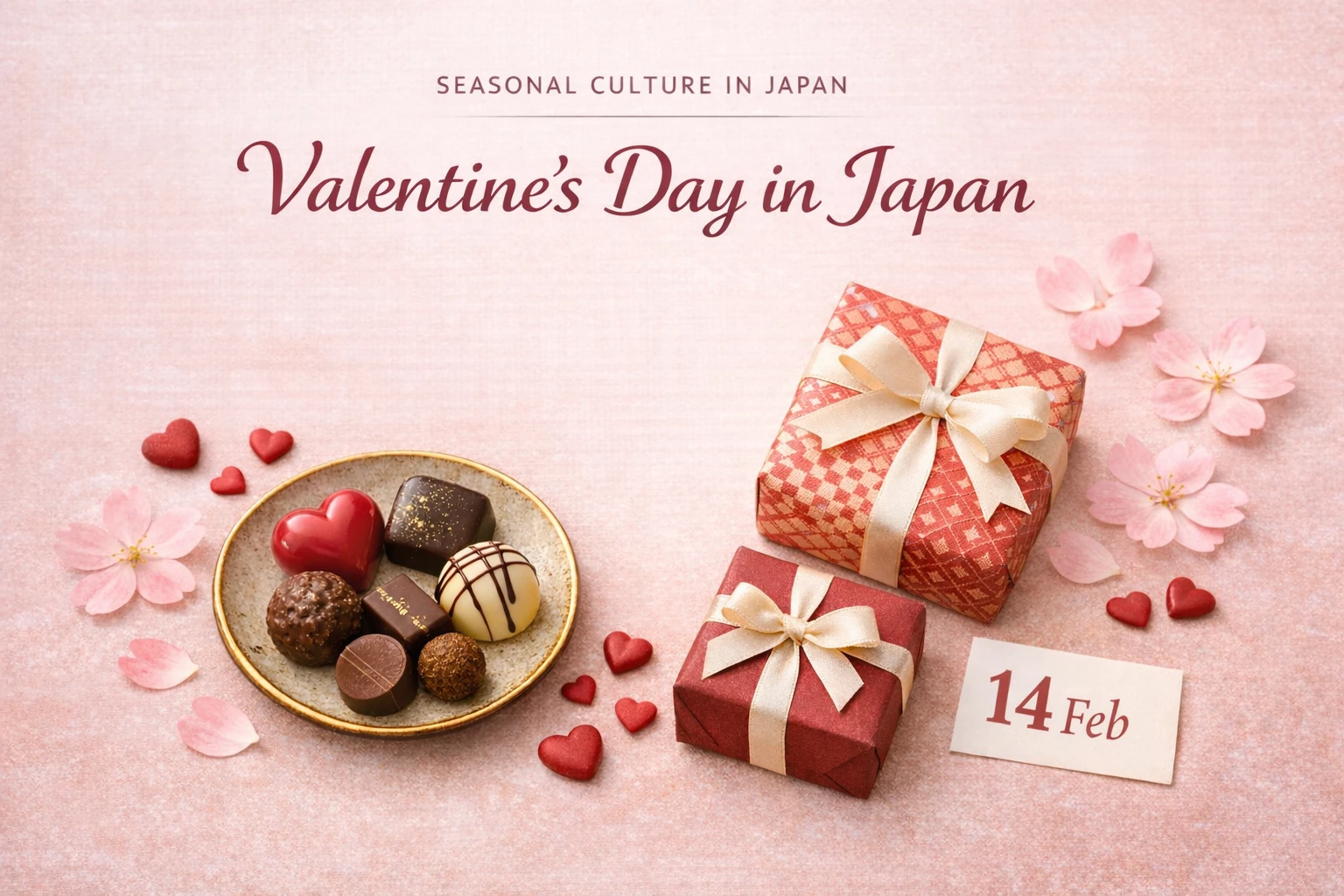

Valentine’s Day in Japan
Valentine’s Day in Japan looks familiar at first glance—hearts, chocolate, and sweet messages— but the customs behind it are quite unique. Unlike many countries, it is usually women who give chocolate on Valentine’s Day in Japan, and there is even a “follow-up” day one month later: White Day. This guide walks you through the key traditions, why chocolate matters, and how travelers can enjoy February in Japan without feeling lost.
- Date
- 14 February (Valentine’s Day)
- Main custom
- Women give chocolates; men reply on White Day (14 March)
- Key terms
- Honmei-choco, Giri-choco, Tomo-choco, “My treat” chocolate
- Good for
- Travelers who love sweets, department-store culture, and people-watching
Keep exploring The Wa Story
What makes Valentine’s Day in Japan unique?
In many countries, Valentine’s Day is a mutual exchange of cards, flowers, or gifts. On Valentine’s Day in Japan, the pattern has traditionally been one-way: women give chocolate to men. This custom is not an ancient practice but a relatively modern story that grew after the idea of Valentine’s Day arrived from overseas.
In the postwar period, confectionery companies, department stores, and women’s magazines played a major role in shaping how the day would look in Japan. Their main customers were women, so early campaigns naturally showed women as the ones taking action on 14 February—buying chocolate and giving it to “the man they like.” As these images appeared in advertisements, shop displays, manga, and TV dramas, the idea that women give chocolate on Valentine’s Day in Japan spread quickly through schools and workplaces.
Some people wonder if this pattern means “Japanese men would never do such a thing,” but it is not really about personality. In everyday life, many Japanese people—men and women—tend to be careful about showing romantic feelings in public. Rather than grand gestures, it is more common to move slowly, read the atmosphere, and choose the right moment. When Valentine’s Day arrived, it was easier for marketers to build a story around women “gathering their courage” on a special day than around men suddenly becoming very demonstrative.
In that sense, the idea that women give chocolate first does not mean Japanese men are unwilling to express affection. Instead, Valentine’s Day and White Day together create a structured way for both sides to show feelings step by step: women give chocolate in February, and men reply one month later with a return gift. Understanding this two-part pattern helps you read the social signals around you if you are staying in Japan through late winter and early spring.
Today, the picture is more flexible. Some people still follow the classic pattern, but others focus on chocolates for friends, family, or themselves. Department stores host huge Valentine fair events where international and Japanese chocolatiers compete to create the most beautiful limited-edition pieces. For visitors, February can feel like a chocolate festival more than a couples-only holiday.
Why it matters: the cultural logic behind Valentine’s chocolate
Valentine’s Day in Japan is often less about a single dramatic confession and more about a shared social “framework” for expressing care. Chocolate works well for that role because it is easy to give, easy to accept, and easy to adjust in tone—serious, friendly, or simply appreciative—without forcing someone to react on the spot.
- A low-pressure way to show care. Small gifts can communicate thoughtfulness without turning a moment into a public performance. That fits a social style where many people prefer subtle signals over big gestures.
- A built-in language of relationships. Labels like giri (courtesy), honmei (romantic), and tomo (friendship) give people a socially understood “reason” for giving—helpful in schools and workplaces.
- A strong gift-culture match. In Japan, wrapping and presentation often carry meaning. Valentine packaging turns a simple sweet into a small story: colors, patterns, and careful design communicate attention.
- A two-part rhythm with White Day. The February gift and the March reply create a paced exchange. It can soften uncertainty by giving both sides time to respond thoughtfully.
- A seasonal “limited edition” mindset. Valentine fairs and special releases fit Japan’s broader love of seasonal collections—like sakura sweets in spring or Halloween snacks in autumn.
For travelers, this is why February can feel like a cultural event even if you are not celebrating as a couple: you are watching a gift system in action—how people balance feelings, relationships, and social comfort through something as simple as chocolate.
Types of chocolate: giri, honmei & tomo
Japanese Valentine’s culture uses several names to describe the “role” of each chocolate. These labels are not strict rules, but they help explain the feeling behind the gift.
Giri-choco: obligation or courtesy chocolate
Giri-choco (義理チョコ) literally means “obligation chocolate.” It is given to colleagues, classmates, or other people you want to thank politely but not romantically. In the past, some offices quietly expected women to give giri-choco to male coworkers. Today, this custom is fading, and many workplaces openly say “no obligation chocolates, please” to avoid pressure.
Honmei-choco: true-feeling chocolate
Honmei-choco (本命チョコ) is “true love chocolate” for a partner or someone you have romantic feelings for. It may be more expensive, handmade, or beautifully wrapped to show special care. For some teenagers, preparing honmei-choco is almost a small coming-of-age ritual: practicing recipes, choosing wrapping, and building up the courage to hand it over.
Tomo-choco: chocolate for friends
Tomo-choco (友チョコ) is chocolate for friends, especially between girls or close classmates. This style grew quickly as people wanted a more relaxed and fun way to enjoy Valentine’s Day in Japan, without focusing only on romance. Exchanging tomo-choco can feel like a small friendship festival: cute, colorful, and stress-free.
“My treat” chocolate and reverse chocolate
In recent years, many women buy special chocolates simply as a gift to themselves. Department stores highlight high-end brands or collaborative collections with the message “Reward yourself.” Some men also give chocolate on 14 February, sometimes called gyaku-choco (reverse chocolate), although it is still less common than the March White Day pattern.
Travel tips: enjoying Valentine’s Day in Japan
If your trip overlaps with Valentine’s Day in Japan, you do not need to plan a big romantic itinerary. Instead, think of it as a seasonal “sweet spot” in the calendar.
- Visit department-store Valentine fairs. Major department stores in Tokyo, Osaka, Kyoto, and other big cities host large chocolate events in late January and early February. You can sample creations from Japanese and international chocolatiers in one place.
- Explore convenience stores and supermarkets. Even ordinary shops switch to Valentine packaging—limited designs with hearts, cherry blossoms, or cute characters. This is an easy place to pick up small gifts for friends back home.
- Look for seasonal café menus. Some cafés offer Valentine-themed desserts or drinks, often with strawberry, chocolate, or matcha combinations. These may overlap with early spring sweets.
- Enjoy people-watching. Around 14 February, you may see students carrying gift bags or handwritten notes, especially in the afternoon. Remember that many people feel shy about it, so observe quietly rather than taking close-up photos.
If you are traveling as a couple, you can of course exchange gifts in your own style. Just remember that in Japanese custom, it is perfectly normal for the woman to give chocolate on 14 February and receive a return gift on White Day one month later.
Cultural meanings behind colors & decor
Valentine displays in Japan use familiar heart motifs, but there are also subtle cultural touches. Pink and red are common, but you may notice pastel colors, simple gold accents, and elegant Japanese patterns on the boxes.
- Pink and red are associated with romance, celebration, and warmth, not only on Valentine’s Day but also in spring events.
- Japanese patterns such as sakura, hemp leaves, or wave designs can appear on packaging, blending Western-style chocolate with traditional motifs.
- Wrapping and presentation are important. Even simple chocolates can feel special when wrapped nicely, reflecting Japan’s wider gift culture.
For many Japanese people, the “story” in the wrapping and the care shown in choosing the gift can matter as much as the chocolate itself. This fits the broader idea of omotenashi—considerate hospitality and attention to detail.
White Day: the follow-up celebration
One of the most surprising points about Valentine’s Day in Japan is that it does not end on 14 February. On White Day, 14 March, men traditionally give return gifts to women who gave them chocolate one month earlier.
Common White Day gifts include cookies, marshmallows, candies, and sometimes jewelry or small accessories. Some people still play with an older idea that certain sweets secretly “answer” the feelings—for example, marshmallows once symbolically meant “I’m returning your feelings,” while other sweets could signal a polite “thank you only.” In everyday life today, most people simply choose something they think the recipient will enjoy.
If you stay in Japan from mid-February to mid-March, you can watch shops slowly shift from red and pink Valentine displays to softer White Day themes. It is like a two-part seasonal story that leads into early spring and, soon after, the first cherry blossoms.
(If you would like to read more once it is ready, we will have a separate guide on White Day in Japan.)
Trivia: little stories behind Japanese Valentine’s Day
- The idea of giving chocolate on 14 February spread widely in Japan only after the late 20th century, supported by marketing campaigns from confectionery companies and department stores.
- Some people jokingly say that buying high-end chocolate “for yourself” has become the real main event, while giri-choco is fading in offices to reduce social pressure.
- Because Valentine’s Day in Japan focuses on sweets, it fits naturally into the wider pattern of seasonal limited editions—similar to cherry blossom desserts in spring or Halloween snacks in autumn.
FAQ: Valentine’s Day in Japan
How is Valentine’s Day in Japan different from other countries?
The biggest difference is that women traditionally give chocolate to men on 14 February, and men respond one month later on White Day. There is also a strong focus on different “types” of chocolate: honmei-choco for romance, giri-choco for courtesy, and tomo-choco for friends.
Do people only give chocolate on Valentine’s Day?
Chocolate is the main symbol, but some people give small gifts like sweets, accessories, or handmade items. However, when shops advertise Valentine’s Day in Japan, they almost always highlight chocolate first.
Is giri-choco still common?
Giri-choco used to be common in workplaces, but many companies and individuals now avoid it to reduce stress and cost. In some offices, people agree not to exchange chocolates at all, or they choose one shared box for everyone instead.
Can travelers join in, or is it only for locals?
Travelers are very welcome to enjoy the seasonal sweets and limited packaging. You can buy chocolates as souvenirs, treat your travel partner, or simply enjoy the displays. Just remember that some people feel shy about giving or receiving chocolates, so keep photos and comments respectful.
Is Valentine’s Day in Japan only for couples?
Not at all. Many people now treat it as a chance to appreciate friends, family, or themselves with small sweets. Romance is one part of the story, but not the only one.
Official resources & further reading
For practical travel information around February and early spring, check:
- Japan National Tourism Organization (JNTO) – Official Travel Guide
- Tokyo Metropolitan Government – Official Travel Guide
Regional city and prefectural tourism websites also share seasonal event information and department-store campaigns, especially in February and March.