
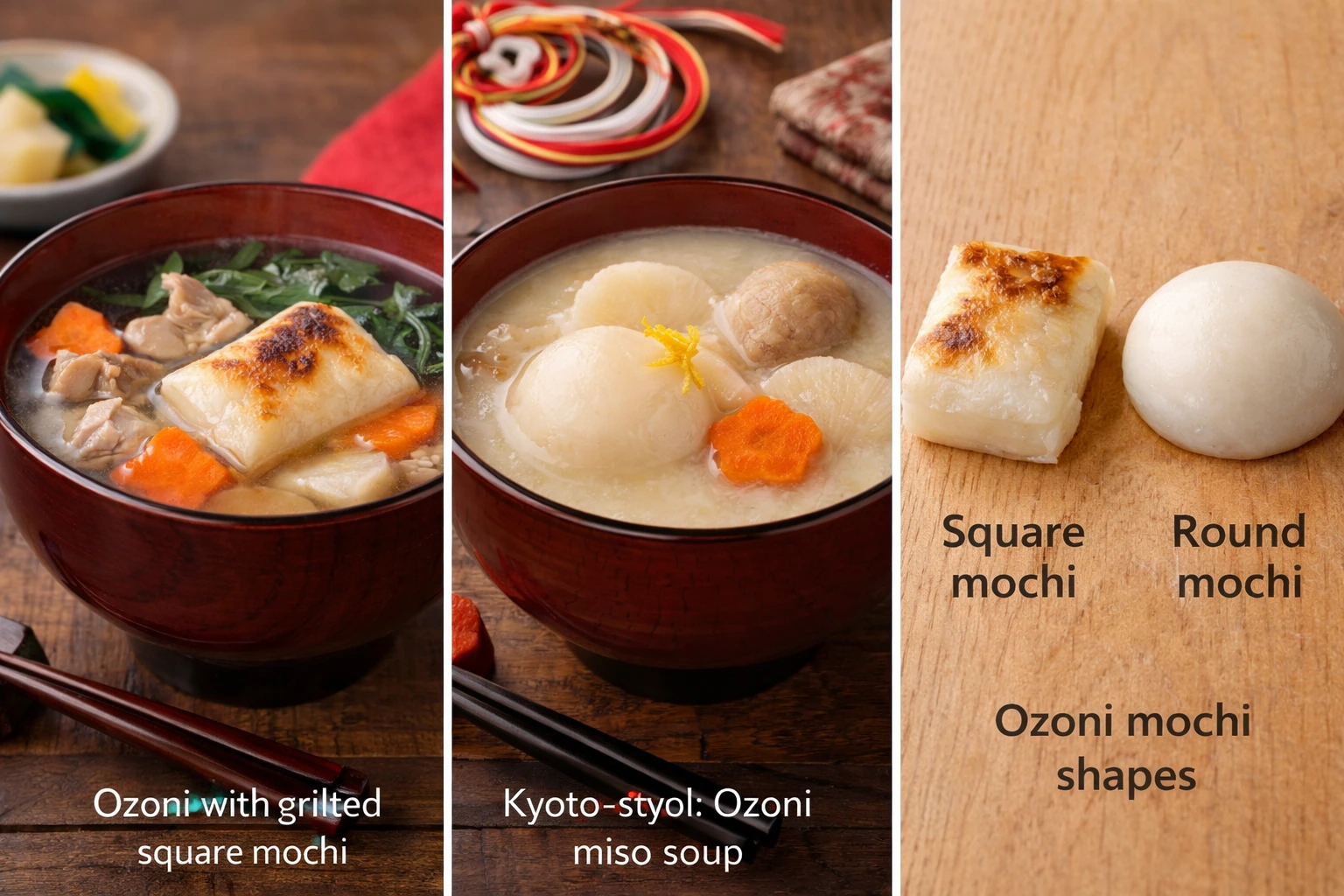

Ozoni
Ozoni (お雑煮) is Japan’s New Year soup with mochi—warm, symbolic, and surprisingly diverse. One family may serve a clear dashi broth with grilled square mochi, while another enjoys a creamy white miso soup with boiled round mochi. The differences aren’t random: Ozoni reflects local ingredients, history, and the good-luck meanings people attach to each bowl. This guide explains what Ozoni is, why it varies so much, and how mochi shape, ingredients, and flavor change from region to region.
- New Year staple: Ozoni is a traditional New Year dish, and it differs by region and even by household.
- Mochi shape: Many eastern areas tend toward grilled square mochi, while many western areas tend toward boiled round mochi.
- Flavor ranges: Clear soy-seasoned broths and miso-based broths are both common; ingredients follow local food culture.
- Safety: Mochi can be a choking hazard—serve small pieces and eat slowly.
What is Ozoni?
Ozoni is a New Year soup served with mochi (rice cake). It’s widely recognized as a traditional New Year dish, but there is no single “correct” version—different regions use different broths, mochi shapes, and ingredients. In other words, Ozoni is a delicious cultural map you can eat.
Why Ozoni varies by region (and by family)
Ozoni reflects local ingredients and taste preferences, and it often carries “good-luck” meanings in the ingredients people choose. That’s why it’s normal to hear, “Our Ozoni is different”—and mean it proudly.
Ozoni by region: mochi shape, ingredients, and flavor
Mochi shape: square vs round
A common pattern is grilled square mochi in many parts of eastern Japan and boiled round mochi in many parts of western Japan. Some areas also have mixed practices depending on community or household.
Flavor styles: clear broths, miso broths, and local signatures
- Clear broth (sumashi-style): Often soy-seasoned dashi with mochi and vegetables; many regional versions exist.
- White miso (Kyoto-style): A creamy, gently sweet miso broth with round mochi and classic winter vegetables.
What goes in the bowl: local “star” ingredients (examples)
- Kyoto: White miso ozoni with round mochi and auspicious ingredients such as kashira-imo and daikon.
- Kagawa: Anmochi zouni—white miso soup featuring a sweet bean-filled mochi.
- Shimane: Sumashi zoni in a clear soy-based dashi with local broth traditions and ingredients.
- Regional seafood versions: Some areas feature fish (for example, amberjack/yellowtail styles).
If you want a simple takeaway: Ozoni changes in three big knobs—mochi shape, broth, and local “star” ingredients. That’s the heart of the tradition.
Safety note: Mochi can be a choking hazard. Keep pieces small, chew well, and take extra care with children and older adults.
An easy “choose-your-style” Ozoni at home
Want Ozoni without overthinking it? Pick one option from each line:
- Mochi: square or round (toast/grill or boil—both are traditional depending on style)
- Broth: clear dashi + soy seasoning or white miso base
- Protein: chicken or fish/seafood (if that matches your region/family)
- Veg: greens + daikon + carrot (swap in local favorites)
- Finisher: yuzu zest, mitsuba, or nori (light aromatics go a long way)
The “correct” Ozoni is the one that fits your place, your people, and your New Year mood.
Travel tips (finding Ozoni flavors in Japan)
- Ask one question: “Is your Ozoni clear broth or miso?” You’ll instantly learn the local direction.
- Look for local pride: Regional Ozoni often appears at ryokan breakfasts and local restaurants around New Year.
- Try a “local-only” bowl: If you spot a name like anmochi zouni, it’s a rare chance to taste a place-specific tradition.
Trivia
- Mochi prep matters: Some regions grill mochi first, while others simmer it directly in the soup.
- Broth identity: Clear broths and white miso broths can feel like completely different dishes—even though both are Ozoni.
- Local ingredients tell a story: A single bowl can reflect mountains vs coast, winter harvests, and household traditions.
FAQ
- Is Ozoni always eaten on January 1?
- It’s strongly associated with New Year, especially the first days of the year, but timing and frequency vary by household.
- Which is “more authentic”—clear broth or white miso?
- Both are authentic. Ozoni is known for regional diversity—broth, ingredients, and mochi shape differ widely.
- Square mochi or round mochi?
- Both are traditional. A broad tendency is square/grilled in parts of eastern Japan and round/boiled in parts of western Japan, with mixed practices in some areas.
- How do I make Ozoni safer to eat?
- Keep mochi pieces small, chew slowly, and supervise children and older adults.
Official Resources
- JNTO: New Year food traditions (includes Ozoni overview)
- MAFF (Gov): Kabu Zou-ni (Turnip Rice Cake Soup) — explains common east/west broth & mochi tendencies
- MAFF (Gov): Ozoni (Our Regional Cuisines)
- MAFF (Gov): Zoni made with white miso (Kyoto)
- MAFF (Gov): Anmochi zouni (Kagawa)
- MAFF (Gov): Sumashi Zoni (Mochi in Soup) (Shimane)
- MAFF (Gov): Buri Zouni (Japanese Amberjack Soup with Mochi)
- MAFF (Gov): Azuki-zoni (sweet azuki-based zoni style)