
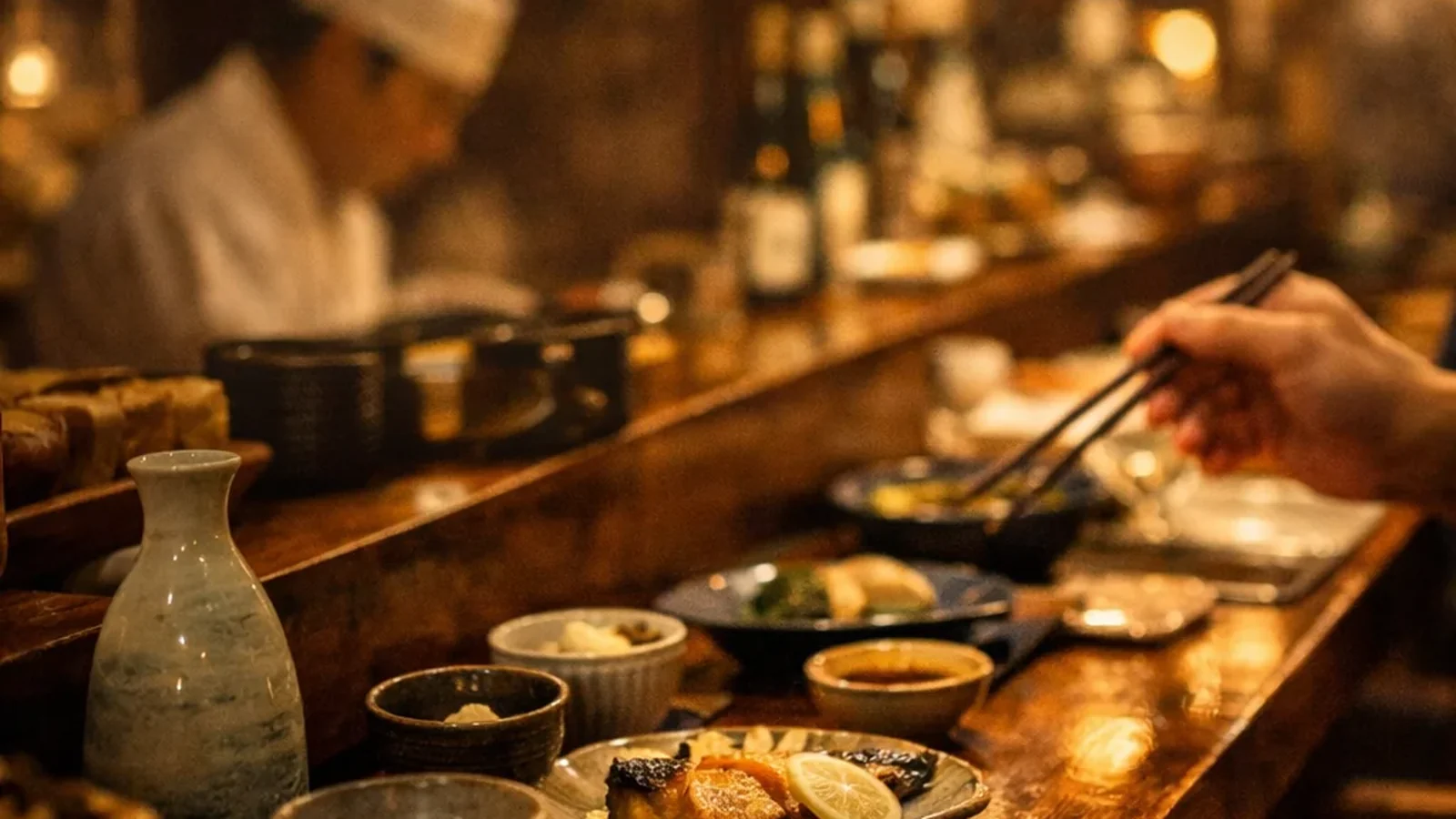

Koryoriya
← Back to the Product: The Wa Jako Collection
Disclosure: This page includes product information and links to The Wa Story Shop. If you buy through these links, The Wa Story may earn revenue.
In a few minutes: A koryōriya is a small Japanese-style eatery where simple dishes and drinks arrive at a calm, human pace—often at a counter. In many office-district neighborhoods, these compact counter rooms become an after-work “reset,” and they can also suit business dinners and relationship-building when you want conversation to stay focused.
- What it is: Simple Japanese plates + alcohol in a compact, often counter-centered room.
- Why it works after work: A steady pace—small dishes, quiet voices, and a room that helps you decompress.
- How to enjoy it: Order slowly, keep your voice soft, and let small plates set the rhythm.
- Bring it home: Chirimen jako turns salad, toast, and pasta into “koryōriya-style” food with almost no prep.
Winter evenings in Japan’s cities have a crisp clarity—brighter station lights, faster footsteps, and a sharper hunger on the way to the last train. That is why a koryōriya can feel like a small miracle: a narrow doorway, a counter within arm’s reach, and dishes that arrive one by one, as if the room is asking you to breathe again.
What is a koryōriya?
Koryōriya (小料理屋) is a Japanese term for a Japanese-style eatery that serves simple dishes and alcohol. It often feels more intimate than a loud, party-style izakaya: fewer seats, quieter conversation, and a sequence of small plates that match the drink and the season.
In many small koryōriya, you’ll meet the chef-owner behind the counter (customers may casually call them taishō), and an okami—the person who quietly keeps the room running. In some places they’re a married couple; in others it’s family, or a small team. The key point is not the staffing style, but the feeling: a room that runs on trust, timing, and warm attention.
A short note on how koryōriya culture formed
Koryōriya culture makes more sense if you see it as part of Japan’s long “eating-out” evolution. In early urban life, people gathered at roadside or temple-front teahouses and simple stalls, then gradually moved toward more specialized places that served food and drink in a more settled, social setting. By the late Edo period, the word koryōriya appears in popular writing, suggesting the idea was already familiar: a small shop offering modest cooking and sake—less formal than high-end banquet dining, but more “room-like” than street food.
Why koryōriya fits after-work comfort (and business dinners)
In many office-district neighborhoods, after-work culture is simple: people want a quiet place to reset, eat something warm, and let the day loosen its grip. Small counter rooms thrive in that mood because they reward patience—one drink, one dish, then the next.
These spaces can also work for business dinners and relationship-building. A calmer atmosphere (sometimes with a counter or small private room) keeps conversation focused. In short: a koryōriya can be both a pressure release and a meeting room—depending on who you’re with.
How a first visit flows
1) Order slowly (this is the secret)
Start with one drink and one dish. Then add plates as you go. A koryōriya shines when dishes arrive at the right temperature, in the right order, without crowding the counter.
2) If it’s a business dinner, let the host set the pace
When the night is for colleagues, clients, or introductions, the “best manners” are simple: follow the host’s timing, keep your voice softer than in a noisy izakaya, and avoid over-ordering early. The room should feel composed, not rushed.
3) Helpful phrases (low-effort, high impact)
- Osusume wa nan desu ka? (What do you recommend?)
- Kore, hitotsu kudasai. (This one, please.)
- Shime wa nani ga ii desu ka? (What’s good to finish with?)
Jako at home: salad, toast, pasta (minimal seasoning)
Here’s the easiest way to bring a koryōriya feeling into your kitchen: keep chirimen jako on hand and treat it as a finishing ingredient. It adds salt, aroma, and umami—so you can keep everything else simple.
Shop note: Link your jako here as the “at-home counter bite.” Explore The Wa Jako Collection (replace with your final collection URL).
Jako salad (no dressing is totally fine)
- Base: baby greens, shredded cabbage, or cucumber ribbons
- Top: sprinkle chirimen jako
- Optional (very light): a tiny squeeze of lemon OR a few drops of olive/sesame oil
If you skip seasoning entirely, it still works—jako already carries enough flavor to act like a “one-ingredient dressing.”
Toast with jako (pan + jako)
- Toast bread.
- (Optional) Add a thin layer of butter or olive oil.
- Scatter jako on top.
- (Optional) Finish with black pepper or lemon zest. Keep it minimal.
This is the fastest “small plate”: crisp, salty, and surprisingly elegant with a citrus finish.
Pasta with jako (quick, clean, and savory)
- (Optional) Warm olive oil with a little garlic, then turn down the heat.
- Toss cooked pasta with a splash of pasta water.
- Turn off heat, then add jako.
- Finish with lemon, shiso, or chopped scallion if you like.
Do not over-salt. Think “aroma + umami,” not heavy sauce.
Two extra koryōriya-style bites (still minimal)
- Cold tofu + jako: tofu, scallion, jako, and (optional) one tiny drip of soy sauce.
- Smashed cucumber + jako: cucumber, jako, and (optional) a few drops of sesame oil.
Travel tips
- Timing: Weeknights in office-district areas can be busy—go early if you want quieter seats.
- Cash: Smaller places vary—carry a little cash.
- Business dinner vibe: If you’re the guest, mirror the host’s pace and ordering style.
- Allergens: Jako is fish—check labels if you have allergies.
Trivia
The “small plate rhythm” is not only about food—it’s about mood control. A counter meal can turn a long day into manageable pieces: one dish, one sip, one reset.
Also, the word koryōriya itself shows up in late Edo-era popular writing, hinting that people already recognized this style of modest cooking-and-drink shop as a familiar part of city life.
FAQ
Is a koryōriya the same as an izakaya?
They overlap. However, “koryōriya” tends to emphasize simple Japanese dishes, a smaller room, and a calmer pace.
Are koryōriya often run by a couple?
Many are small and owner-led, so you may meet a chef-owner and an okami running the floor. Still, it varies—some are family-run, and some are operated by a small team.
Can I really use jako without seasoning?
Yes. For salad especially, jako can function as the main flavor. If you want a tiny upgrade, add only lemon or a few drops of oil.