
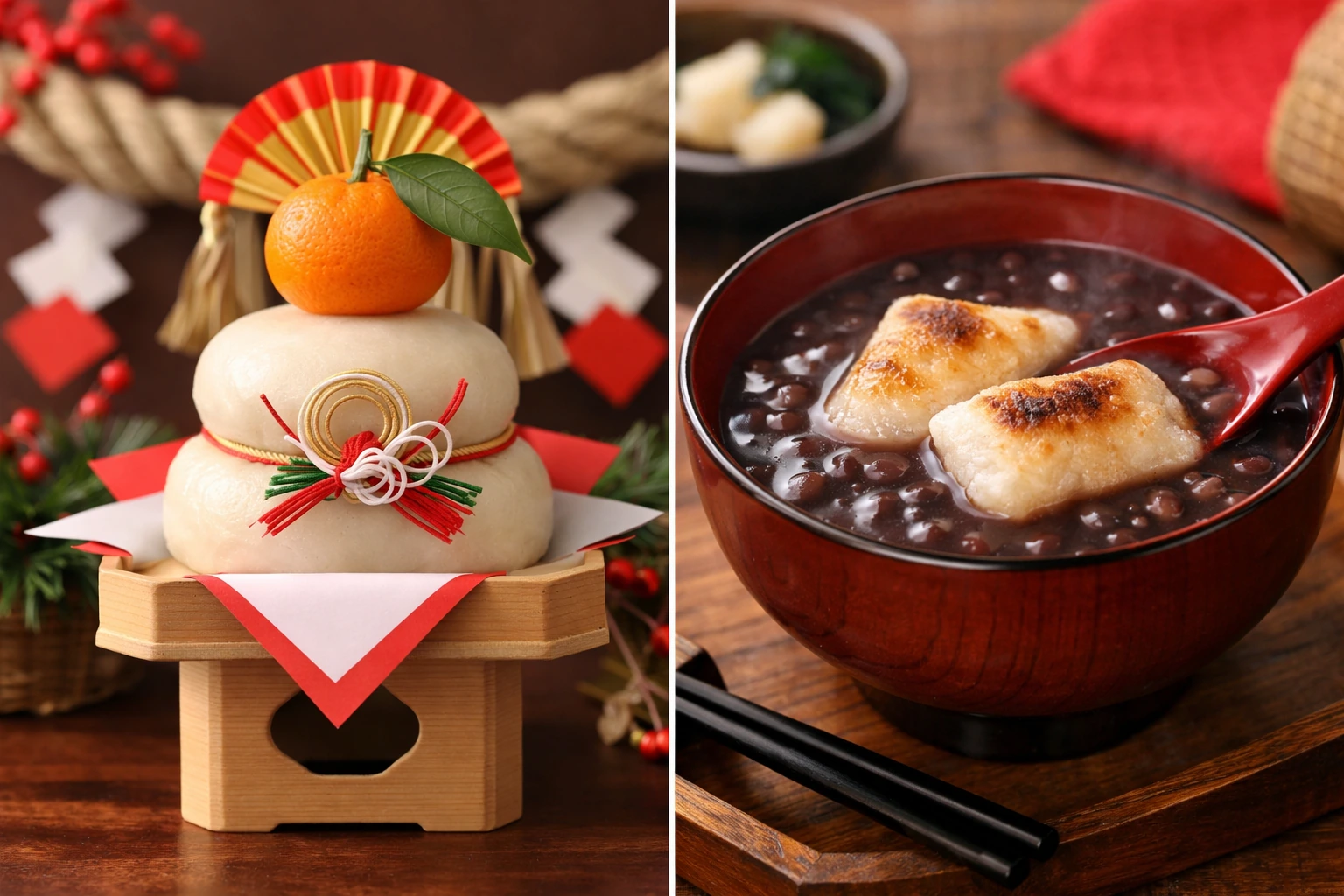

Kagami Biraki
Kagami Biraki (鏡開き) is the moment Japan “opens” the New Year’s kagami mochi—breaking it into pieces and eating it to welcome good health and good fortune. The key is the verb: we don’t “cut” mochi. We open it—gently, safely, and with gratitude for the blessings believed to rest in the offering. Below is the simple meaning, the common date (and regional variations), an easy at-home method, and comforting ways to enjoy it like sweet red bean soup with toasted mochi.
- Date: Often observed on January 11, but some regions keep different dates.
- Words matter: Avoid “cutting” with a knife; you “open” (break) the mochi for auspicious meaning.
- Best ways to eat it: Toasted mochi, sweet red bean soup, okaki (crispy rice crackers), or savory soups.
- Safety: Serve in small pieces and eat slowly—mochi can be a choking hazard.
Kagami Biraki: what it is and why it matters
Kagami mochi is the stacked round mochi displayed during the New Year—an offering associated with the visiting New Year deity (toshigami, 年神) and a wish for harmony and a good year. Kagami Biraki is the “closing chapter”: you remove the mochi, break it into bite-size pieces, and share it—turning a beautiful decoration into a warm, edible blessing.
Think of it as a gentle cultural rhythm: display → thank → share → begin again. It’s practical (you don’t waste food), and it’s symbolic (you bring the good-year wish into your daily life).
When is Kagami Biraki?
In many places, Kagami Biraki is observed on January 11. However, the date can vary by region and household. If you’re writing for travelers, the safest phrasing is “often January 11 (regional variations exist).” If you’re writing for residents, follow your local custom—or your family’s.
Why “open” mochi (and not cut it)
The language is part of the charm. “Open” (hiraku, 開く) is auspicious—suggesting luck unfolding. By contrast, “cutting” can sound like cutting ties, and knife imagery can feel too sharp for a New Year ritual. That’s why the mochi is traditionally broken by hand or with a wooden mallet, not sliced with a blade.
Many people also avoid saying “break” (waru, 割る) directly and keep the softer expression “open.” It’s a small linguistic choice that carries a big cultural mood: start the year gently.
How to do Kagami Biraki at home
- Remove decorations. Take off the daidai (bitter orange) and paper ornaments. If you have a modern plastic kagami mochi, open it and take out the real mochi inside (don’t hit plastic with a mallet).
- Let it dry (optional but common). If the mochi is already hard, great. If it’s still soft, leaving it out briefly helps it firm up.
- “Open” it. Wrap the mochi in a clean cloth or place it in a sturdy bag, then gently tap with a wooden mallet (or break by hand) into small pieces.
- If it’s too hard, soften it. Soak pieces in water for a few hours, then tear by hand into smaller chunks.
- Cook before eating. Toast, simmer, or bake until soft and hot inside.
Safety note: Mochi can be a choking hazard. Serve small pieces, eat slowly, and take extra care with children and older adults. (If you’re serving elders, consider softer preparations and keep watch while eating.)
What to cook with kagami mochi
Sweet (classic winter comfort)
- Sweet red bean soup + toasted mochi: A cozy winter staple—names and styles vary by region and household.
- Kinako mochi: Toasted mochi rolled in roasted soybean flour + sugar + a pinch of salt.
Savory (easy meal mode)
- Ozoni-style soup: Add toasted mochi to a light dashi-based soup with greens and mushrooms.
- Isobe-yaki: Toasted mochi brushed with soy sauce and wrapped in nori.
Crunchy (use up small bits)
- Okaki / arare: Dry mochi pieces thoroughly, then bake or fry for crisp rice crackers. Finish with salt or soy-sugar glaze.
Kagami Biraki beyond the home: dojos & sake barrels
You may also hear “Kagami Biraki” in two other settings:
- Martial arts dojos: Some dojos hold a Kagami Biraki gathering as their first practice of the year—an “opening” of training and spirit.
- Sake barrel ceremonies: At celebrations, people sometimes “open” a sake barrel (breaking the wooden lid) to mark an auspicious start.
Same phrase, same feeling: a communal beginning—done with good luck in mind.
Travel tips (if you’re in Japan in early January)
- Try it in dessert form: Look for sweet red bean soup with mochi on winter menus—especially at wagashi shops and kissaten-style cafes.
- Shop smart: Convenience stores often sell small mochi packs if you don’t have kagami mochi.
- Ask locally: If you’re staying with family or in a rural area, ask which date they follow—regional New Year customs differ.
Trivia
- Why “kagami”? “Kagami” means mirror. The round mochi shape is often linked to traditional round mirrors—symbols of wholeness.
- Language as ritual: Choosing “open” over “break” is part of Japan’s New Year habit of speaking gently to invite good fortune.
- Nothing wasted: Kagami Biraki turns a New Year display into shared food—gratitude you can taste.
FAQ
- Can I cut kagami mochi with a knife?
- Traditionally, it’s avoided. If you must portion it for safety, soften it first (soak/simmer) and then separate gently into small pieces.
- What if my kagami mochi is the plastic type?
- Many modern decorations contain real mochi inside. Open the package, remove the mochi, and “open” the mochi itself—don’t strike the plastic casing.
- Is Kagami Biraki always January 11?
- It’s common, but not universal. Some regions observe different dates tied to local New Year customs.
- What’s the safest way to eat mochi?
- Keep pieces small, chew well, and eat slowly. Take special care with children and older adults, and avoid “washing it down” before it’s chewed.
Official Resources
- JNTO: Meaning of New Year’s Mochi (includes kagami-biraki on Jan 11)
- MAFF (Gov): Our Regional Cuisines — Mayudama (mentions Kagamibiraki on January 11)
- Government of Japan (Gov-Online): The Role of Sake in Japanese Traditional Rituals (kagami-biraki ceremony)
- Fukushima Prefecture: Let’s prevent choking accidents caused by rice cakes (mochi)