
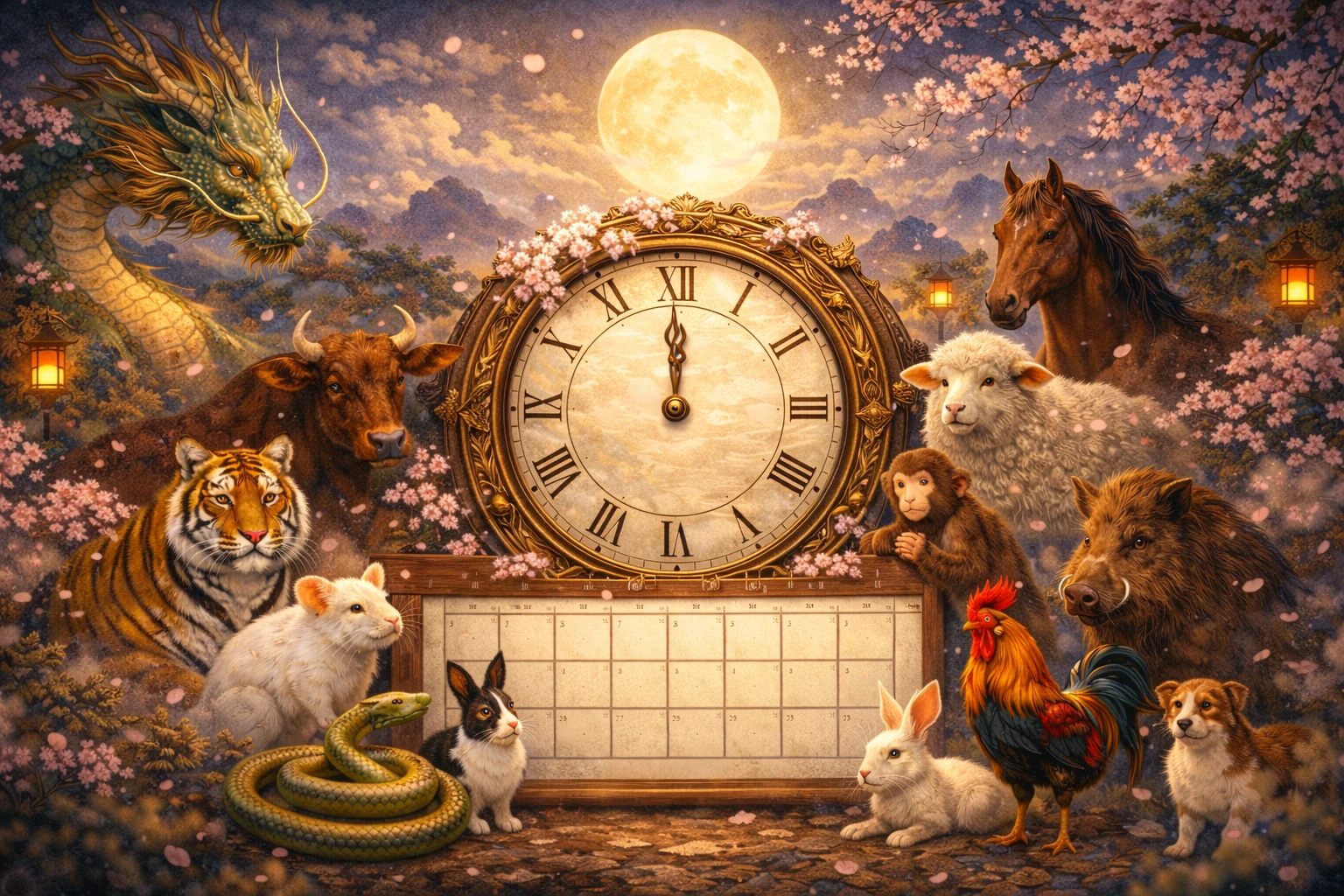

Japanese zodiac meaning
Japanese zodiac meaning is not only about personality or fortune. In Japan, the zodiac is tied to an older way of organizing time, seasons, and everyday life. Once you see how the system works, the 12 animals start to feel less like a list and more like a cultural way of understanding time itself.
Contents
What is the Japanese zodiac, really?
The Japanese zodiac is commonly known through 12 animals, but behind those animals is an older time system. In Japan, this zodiac is usually understood through jūnishi (十二支), the twelve signs used in a repeating cycle.
Today, many people meet the zodiac through New Year traditions or by checking their birth year. However, the deeper idea is not simply “Which animal are you?” It is also about how time moves in patterns that return.
That is why the zodiac feels different from a simple horoscope list. It sits somewhere between calendar, symbol, and cultural memory.
Why are there 12 animals?
The number 12 is not random. In older East Asian systems, time was divided into 12 repeating units. A full cycle of years could also be counted through 12 signs, which made the system easy to reuse and remember.
Because of this, the zodiac was never just decoration. The 12 signs helped people place events within a repeating order.
This is one reason the zodiac still feels natural in Japan. It matches a broader cultural comfort with cycles: the return of seasons, annual customs, and familiar turning points in the year.
It was not only used for years
This is the part many visitors do not realize: the zodiac was not only associated with years.
Traditionally, the 12 signs were also connected with hours of the day and directions. That older way of thinking still survives faintly in modern Japanese.
This becomes easier to understand when you look at how a day was structured.
Instead of 24 hours, a day was divided into 12 segments. Each segment corresponded to one zodiac sign.
Example: Here are a few zodiac hours to show how the system worked across the day.
| Sign | Time | Meaning in the day |
|---|---|---|
| Rat (子) | 23:00–1:00 | Midnight |
| Rabbit (卯) | 5:00–7:00 | Sunrise |
| Horse (午) | 11:00–13:00 | Midday (sun at its highest) |
| Rooster (酉) | 17:00–19:00 | Sunset / evening |
In this system, the Horse represents the middle of the day, when the sun is highest in the sky.
This is why modern words like gozen (午前, before noon), gogo (午後, after noon), and shōgo (正午, exact noon) still contain the sign go (午).
So when you look at the zodiac in Japan, you are not only looking at birth years. You are looking at traces of an older way of organizing time itself.
Why animals are used
Animals make the system memorable. Abstract signs are harder to hold in the mind, but animals turn the cycle into something visible and easy to pass on.
They also connect time to the natural world. Instead of feeling mechanical, the cycle feels alive. That matters in Japan, where seasonal awareness and small recurring rituals remain important parts of everyday culture.
In other words, the animals help transform a time system into a shared cultural language.
Why this order is remembered through a story
Many people know the order of the zodiac through the familiar story of a race. Whether told in a playful or simplified form, the story works as a memory tool. It helps children and adults remember the sequence through narrative rather than memorization alone.
The story also reveals something cultural. The order is not remembered through force alone, but through timing, chance, cleverness, and movement. That makes the zodiac feel less like a dry system and more like something lived and retold.
This is part of why the zodiac stays memorable across generations.
Why it is still used today
The zodiac remains visible in modern Japan, especially around the New Year. New Year cards often feature the zodiac animal of the coming year, and zodiac-themed decorations appear in shops, homes, shrines, and seasonal goods.
This use is usually light and familiar rather than intensely religious. The zodiac helps mark the feeling of entering a new cycle together.
That is why it still works so well today. It offers a simple symbolic way to say, “A new year has begun.”
What this reveals about Japanese culture
The Japanese zodiac suggests a way of seeing time that is cyclical rather than purely linear. Time does not only move forward. It also returns.
That perspective fits closely with Japanese seasonal life, where repeating customs still carry meaning each year: New Year visits, spring flowers, summer festivals, autumn harvests, and winter preparations.
Seen this way, the zodiac is not mainly about prediction. It is about placement, rhythm, and continuity. It helps people feel where they are in time.
So what does this actually change?
It changes how you see Japan.
Once you understand the zodiac as a way of organizing time, small details begin to look different. Zodiac animals on New Year cards, seasonal decorations, shrine displays, and everyday goods are no longer just cute symbols. They mark a shared moment in time.
In other words, the zodiac is not mainly about prediction. It is about recognition.
It helps people feel that they are entering the same season, the same year, and the same turning point together.
That is why the zodiac still makes sense in modern Japan. It offers a simple way to connect personal life with a larger cultural rhythm.
So when you say, “I am a Dragon” or “I was born in the Year of the Rabbit,” you are not only naming an animal. You are placing yourself within a shared cycle of time.
See how older ideas of time still shape Japan’s calendar and seasonal life →
Trivia
- The zodiac in Japan is often called eto (干支), although the word can also connect to a broader traditional cyclical system.
- Older time language in Japanese still preserves zodiac traces, especially around noon.
- New Year cards commonly show the zodiac animal of the coming year.
FAQ
Is the Japanese zodiac only about birth years?
No. Today, people often use it that way, but traditionally the 12 signs were also connected to time and direction.
Why are animals used in the Japanese zodiac?
Animals make the system easier to remember and help connect an abstract cycle to familiar images from everyday life and nature.
Do Japanese people treat the zodiac like fortune-telling?
Sometimes in a light, casual way, but in everyday life it is often more cultural and seasonal than predictive.
Why does the zodiac appear so often at New Year?
Because it is a familiar symbol of entering a new annual cycle, which fits naturally with New Year customs in Japan.