
Zen
Zen aesthetics in Japan is a key concept that focuses on simplicity, space, and impermanence.
Zen aesthetics in Japan is often associated with simplicity, stillness, and quiet beauty. However, it is not only a visual style. It is also a way of seeing the world—one that values impermanence, restraint, emptiness, and careful attention to the present moment.
This is why Zen aesthetics appears in so many parts of Japanese culture. You can feel it in garden design, tea spaces, ink painting, architecture, pottery, and the use of empty space. Rather than trying to impress through excess, it often creates meaning through calm balance and subtle depth.
In this guide: what Zen aesthetics means, how it developed, which core ideas shape it, where it appears in Japanese culture, and why it still matters today.
Contents
- What is Zen aesthetics?
- Why Zen aesthetics feels different
- Historical background
- Core ideas in Zen aesthetics
- Simplicity and restraint
- Emptiness and space
- Impermanence and irregularity
- Zen aesthetics in Japanese culture
- Zen gardens and tea culture
- What Zen aesthetics is not
- Why it matters today
- Trivia
- FAQ
- Related guides
- External resources
What is Zen aesthetics?
Zen aesthetics is a way of understanding beauty through simplicity, awareness, and quiet presence. It often values what is subtle rather than grand, what is suggestive rather than explicit, and what feels balanced without looking overly controlled.
Although it is often linked to Zen Buddhism, Zen aesthetics is not limited to religion alone. Over time, it shaped broader Japanese taste and influenced the way people arranged space, appreciated objects, and understood atmosphere.
That is why Zen aesthetics is best understood not as decoration, but as an attitude toward beauty. It asks us to notice what is easily missed: the pause, the texture, the shadow, the incomplete form, the calm between things.
Why Zen aesthetics feels different
Zen aesthetics often feels different from styles that emphasize display, symmetry, or visual richness. Instead of trying to fill every space, it often leaves room. Instead of making everything perfect, it may allow roughness or natural irregularity to remain visible.
This difference is important. In Zen-influenced aesthetics, beauty is not always found in polish or fullness. It may appear in weathered surfaces, quiet materials, muted color, empty space, or a sense that something is passing and cannot be held forever.
Historical background
Zen Buddhism became especially influential in Japan during the medieval period, particularly among the military elite. Over time, Zen practices and related ways of seeing influenced ink painting, garden design, architecture, and tea culture.
During the Muromachi period and the culture associated with Higashiyama in Kyoto, artistic ideals linked to restraint, contemplation, and understated beauty became more visible. Tea gatherings, monochrome ink painting, and carefully designed spaces all helped shape what later came to be recognized as a distinct Japanese aesthetic language.
Core ideas in Zen aesthetics
Zen aesthetics is not based on only one concept. Instead, it brings together several related ways of seeing. While different schools and traditions emphasize different points, a few recurring ideas appear again and again.
- Simplicity: reducing distraction and allowing essentials to stand clearly.
- Space: leaving room for pause, breath, and attention.
- Impermanence: recognizing that beauty is often linked to passing time.
- Irregularity: allowing natural forms and incomplete surfaces to remain visible.
- Presence: treating the moment in front of you as meaningful in itself.
Simplicity and restraint
One of the clearest features of Zen aesthetics is simplicity. This does not mean emptiness for its own sake, nor does it mean poverty of expression. Rather, it means removing what is unnecessary so that what remains can be more deeply felt.
Restraint is important here. A room, object, or composition may feel calm because nothing is trying too hard to dominate. Materials are often allowed to speak quietly. The effect is not plainness in a negative sense, but clarity without excess.
Emptiness and space
Zen aesthetics often values empty space as much as visible form. In Japanese culture, this relates closely to the idea of ma, meaningful space or interval. A pause in conversation, an open area in a room, or the space around an object can shape the entire experience.
Because of this, emptiness is not treated as absence alone. It can become part of the design itself. What is left unfilled invites attention, quiet, and reflection.
Impermanence and irregularity
Another important aspect of Zen aesthetics is the acceptance of change and incompleteness. Beauty is not always tied to permanence or perfect finish. A slightly uneven tea bowl, weathered wood, moss on stone, or fading color may all carry emotional depth.
This is also where ideas related to wabi-sabi begin to appear more clearly. Wabi-sabi is not identical to Zen aesthetics as a whole, but it overlaps strongly with it through its appreciation of impermanence, incompleteness, and humble beauty.
Zen aesthetics in Japanese culture
Zen aesthetics appears in many different cultural forms. It can be seen in the quiet lines of architecture, the restraint of monochrome ink painting, the subtle atmosphere of a tea room, the use of natural materials, and the pacing of a garden path.
It also affects the way objects are appreciated. A hand-formed tea bowl may be valued not despite its unevenness, but partly because of it. A space may feel beautiful not because it is filled, but because it allows the eye and mind to rest.
In this sense, Zen aesthetics is not confined to art. It shapes how beauty is recognized in ordinary things.
Zen gardens and tea culture
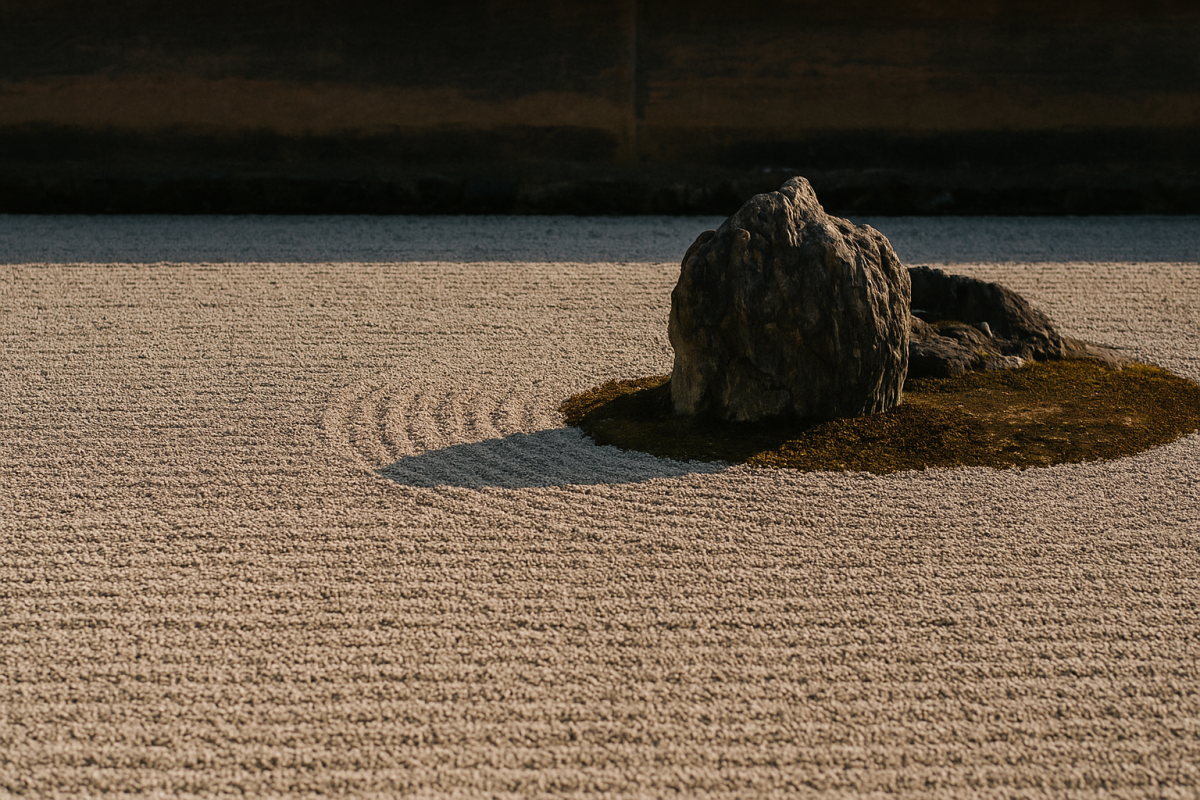
Zen gardens are often one of the first images people associate with Zen aesthetics. Raked gravel, stone, moss, and carefully limited planting can create a space that feels contemplative rather than decorative. Such gardens do not simply represent nature. They also invite reflection through suggestion and stillness.
Tea culture is another major expression of Zen aesthetics. The tea ceremony values harmony, respect, purity, and tranquility, and it often favors humble objects, quiet materials, and close attention to the moment. This is one reason tea culture became such an important place for the development of wabi-sabi and related aesthetic ideas.
What Zen aesthetics is not
Not just minimalism
Zen aesthetics is often described as minimalism, but that is too narrow. Minimalism can be purely visual. Zen aesthetics is also philosophical and atmospheric.
Not cold emptiness
Empty space in Zen aesthetics is not meant to feel sterile. Ideally, it creates calm, attention, and depth.
Not the same as wabi-sabi
Wabi-sabi overlaps strongly with Zen aesthetics, but the two are not identical. Wabi-sabi deserves its own deeper explanation because it focuses more specifically on imperfection, transience, and humble beauty.
Why it matters today
Zen aesthetics still matters because it offers a different way of valuing the world. In a culture often dominated by speed, stimulation, and visual overload, it reminds us that quietness, space, and incompleteness can also hold beauty.
It also helps explain why so many Japanese cultural forms feel distinctive. From gardens and pottery to tea and architecture, Zen aesthetics continues to shape how atmosphere, material, and attention come together.
Trivia
The Silver Pavilion in Kyoto is often described as a classic example of the wabi-sabi aesthetic, and the culture around it strongly influenced tea, gardens, poetry, and architecture. Although it was never covered in silver as originally planned, its unfinished appearance became part of its aesthetic power.
FAQ
Is Zen aesthetics the same as Japanese minimalism?
No. There is overlap, but Zen aesthetics is broader and includes philosophical ideas about space, impermanence, and awareness.
Is wabi-sabi part of Zen aesthetics?
Yes, but it is better seen as a closely related concept within a wider aesthetic world rather than as a perfect synonym.
Do I need to understand Buddhism to understand Zen aesthetics?
No. Buddhist background helps, but many aspects of Zen aesthetics can be appreciated through art, space, and everyday cultural experience.
Where can I see Zen aesthetics in Japan?
It appears in gardens, tea rooms, temples, pottery, architecture, and many traditional arts shaped by restraint and contemplation.
Related guides
- Japanese Tea Ceremony
- What Is “Wa” in Japanese Culture?
- Shinto and Buddhism in Japan
- Wabi-Sabi (Coming)