
Bowing in Japan
← Back to Japanese Culture Guides
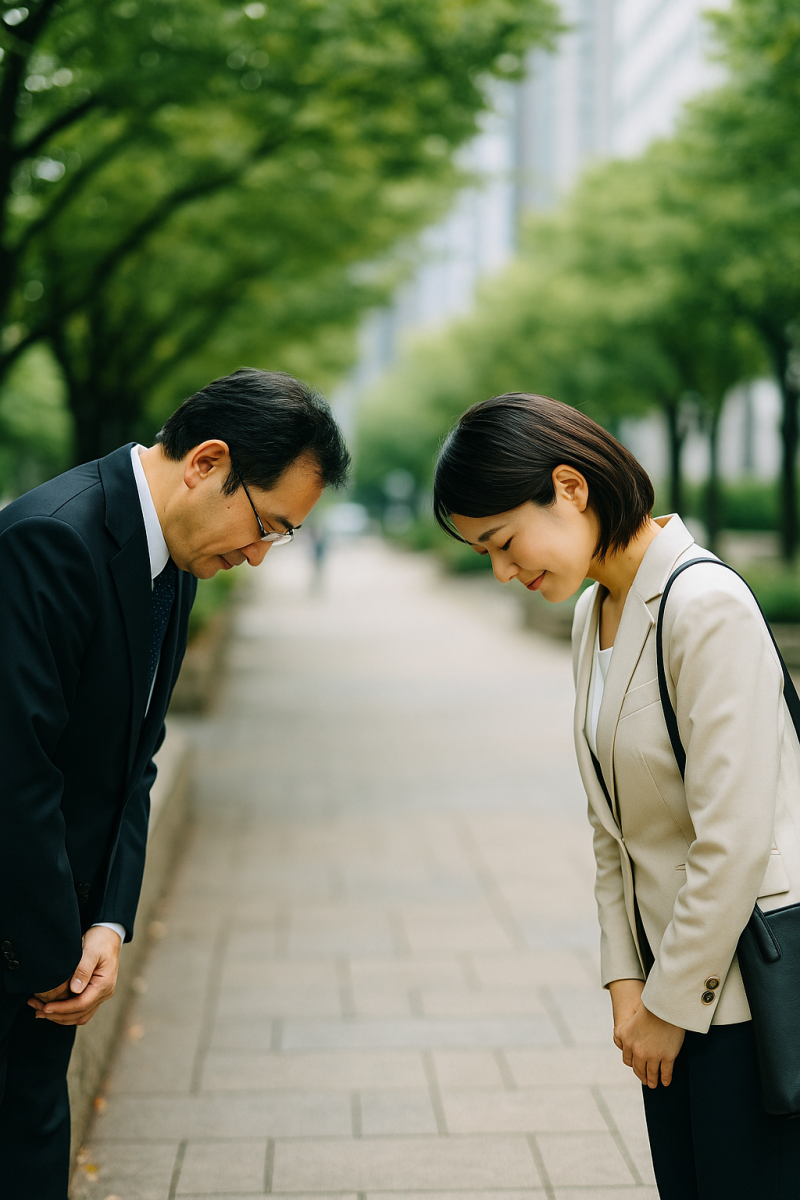
In one minute: Bowing in Japan is part of aisatsu (挨拶), the small rituals that help keep interactions calm and comfortable. In Japanese, bowing is called ojigi (お辞儀). For most travelers, the safest habit is simple: a calm phrase + a light bow or nod is already polite.
- Safest default: Smile + “Konnichiwa” + a light bow (~15°).
- Service moments: A nod + “Arigatō gozaimasu” goes a long way.
- Meals: “Itadakimasu” (before) / “Gochisōsama deshita” (after).
- Unsure? Choose “Sumimasen”—it can mean excuse me, sorry, or thanks depending on the moment.
Who bows in Japan? (and who you’ll bow to)
First, it helps to know that bowing in Japan appears in everyday life, not only in formal or traditional settings. As a traveler, you will notice bowing between:
- Customers and staff in shops, restaurants, and hotels
- Strangers in elevators, hallways, and crowded sidewalks
- Colleagues in workplaces and meetings
- Neighbors in apartment buildings and local communities
- Hosts and guests when visiting someone’s home
Travel-safe rule: If someone bows to you, simply bow or nod back. Even a small response feels polite and natural.
What is bowing in Japan?
Bowing in Japan is a body language of greeting, respect, gratitude, apology, and social awareness. In Japanese, this bowing is called ojigi (お辞儀).
More broadly, bowing belongs to aisatsu (挨拶), the everyday rituals that make interactions smoother and more predictable. Rather than being dramatic, most bows are quiet signals that say, “I recognize you,” “thank you,” “sorry,” or “this interaction matters.”
Helpful analogy: In many everyday situations, a light bow works a bit like saying “hello” or “thank you” with your body. However, in Japan, the same gesture can also carry apology or respect depending on its timing and depth.
Where Japanese people bow
In daily life, most bows are small and practical. You will often see micro-bows or light bows rather than deep formal ones. Deeper bows are usually reserved for formal thanks, introductions, or serious apologies.
| Place / setting | Typical moment | Usual bow | What it signals | What you can do today |
|---|---|---|---|---|
| Shops | Entering, paying, leaving | Nod or Eshaku (~15°) | “I see you / thank you” | Smile + small nod, then say “Arigatō gozaimasu” at checkout |
| Restaurants and cafés | Getting attention, receiving service, leaving | Nod or Eshaku (~15°) | Polite request + clean ending | Use “Sumimasen,” then finish with one light bow when leaving |
| Hotels and ryokan | Check-in, check-out, thanks for help | Keirei (~30–45°) in formal moments | Respect + gratitude | Offer one calm respectful bow with “Arigatō gozaimasu” |
| Building entrances and elevators | Passing strangers, making space | Micro-nod | Nonverbal courtesy | When someone makes space, acknowledge it with a small nod |
| Public transit | Passing through, asking a question, receiving help | Micro-nod | Respect for shared space | In crowded areas, “Sumimasen” + a slight nod works well |
| Clinics and hospitals | Greeting reception, thanking staff | Eshaku (~15°) | Polite acknowledgement | After help, say “Arigatō gozaimasu” with a light bow |
| Neighbors and local communities | Passing in hallways, quick greetings | Micro-nod or Eshaku | Friendly social harmony | A simple “Konnichiwa” + small nod feels natural |
| Homes | Entering, leaving, thanking for hospitality | Eshaku to Keirei | Respect for the person and the space | At entry, a light bow; at exit, thanks + one calm bow |
| Ceremonies | Formal greetings, condolences, thanks | Keirei or deeper | Deep respect | Keep it simple and follow the local flow |
When to bow
Next, focus on boundaries. In Japan, bows often appear at the beginning and end of interactions. That is why remembering these small moments makes etiquette much easier.
| Boundary moment | Typical example | Common bow | Travel-safe action |
|---|---|---|---|
| Enter / exit | Entering or leaving a shop, hotel, or room | Micro-nod or ~15° | Pause briefly, then offer one calm nod or light bow |
| Begin / end | Starting or closing a conversation, meeting, or introduction | ~15° to ~30° | Match the other person’s tone instead of forcing a deep bow |
| Request / receive | Asking for help, receiving service or an item | Micro-nod | Say a short phrase, then nod |
| Apology | Bumping someone or causing trouble | ~15° to ~30° | “Sumimasen” + a small bow is the safest default |
Why bowing matters in Japanese culture
Why do Japanese people bow so often? Put simply, bowing in Japan helps protect harmony, or wa (和). It lets people express respect, thanks, apology, and awareness without needing many words.
- Clarity: it shows when an interaction begins or ends.
- Respect: it signals that the moment and the other person matter.
- Social ease: it reduces friction in shared spaces.
That is why bowing is not only a “traditional custom.” It is also a practical part of modern everyday life in Japan.
How to bow naturally
Now for the practical side: angles are only guidelines. In real life, calm timing and natural movement matter more than mathematical precision.
| Type | Typical angle | When to use | Travel note |
|---|---|---|---|
| Eshaku (会釈) | ~15° | Daily greetings, quick thanks, passing someone | Best default for travelers |
| Keirei (敬礼) | ~30–45° | Introductions, formal thanks, serious apology | Useful at hotels, ryokan, and formal situations |
| Saikeirei (最敬礼) | 45°+ | Deep respect or very serious apology | Rare; do not force it |
How to bow in simple steps
- First, stop: bowing while walking can look rushed.
- Then bend from the hips: keep your back long rather than dipping only your neck.
- Next, pause briefly: about one second at the bottom is enough.
- Finally, return calmly: do not snap back up.
Luggage and seated situations
- With a backpack or luggage: keep bows smaller so you stay balanced and avoid bumping others.
- When seated: a small forward incline is enough, especially in tight spaces.
Today’s safest habit: one light bow or nod, done calmly, is better than a perfect angle done awkwardly.
What to say when you bow
In Japan, bowing often works together with a short phrase. That is why the easiest pattern for travelers is simple: a small bow or nod + a calm one-line phrase.
Good to know: When staff say “Irasshaimase” (Welcome), you do not need to reply. A smile and small nod is enough.
| Moment | Say | Do |
|---|---|---|
| Getting attention | Sumimasen | Small nod or light bow |
| Receiving help or service | Arigatō gozaimasu | Light bow (~15°) |
| Passing in tight spaces | Sumimasen | Micro-nod |
Essential phrases
| Situation | Japanese | Romaji | Meaning |
|---|---|---|---|
| Hello / greeting | こんにちは | Konnichiwa | Hello / good day |
| Polite thank you | ありがとうございます | Arigatō gozaimasu | Thank you |
| Excuse me / sorry / thanks | すみません | Sumimasen | Excuse me / I’m sorry / thanks |
| Please / request | お願いします | Onegaishimasu | Please / I’d like to ask |
| Nice to meet you | はじめまして | Hajimemashite | Nice to meet you |
Time-based greetings
| Time | Japanese | Romaji | Meaning |
|---|---|---|---|
| Morning | おはようございます | Ohayō gozaimasu | Good morning |
| Daytime | こんにちは | Konnichiwa | Hello / good day |
| Evening | こんばんは | Konbanwa | Good evening |
Meals and thanks
| Moment | Japanese | Romaji | Note |
|---|---|---|---|
| Before eating | いただきます | Itadakimasu | Gratitude before the meal |
| After eating | ごちそうさまでした | Gochisōsama deshita | Thanks for the meal and hospitality |
| Simple compliment | おいしいです | Oishii desu | Easy and positive |
Service culture phrases
| Phrase | Japanese | Romaji | What to do |
|---|---|---|---|
| Irasshaimase | いらっしゃいませ | Irasshaimase | Smile or nod; no reply needed |
| Shitsurei shimasu | 失礼します | Shitsurei shimasu | Formal “excuse me,” often for rooms or calls |
| Otsukaresama desu | おつかれさまです | Otsukaresama desu | If said to you, it is usually safe to say back |
Politeness levels
After that, adjust your words by strength. For travel, the first line is usually enough.
Apologies (light to strong)
| Strength | Japanese | Romaji | Use it when… |
|---|---|---|---|
| Light / multipurpose | すみません | Sumimasen | Passing, small mistakes, getting attention |
| More direct | ごめんなさい | Gomen nasai | Personal apology |
| Very formal | 申し訳ありません | Mōshiwake arimasen | Serious apology, rare in travel situations |
Requests (the “please” toolkit)
| Goal | Japanese | Romaji | Example use |
|---|---|---|---|
| General “please” | お願いします | Onegaishimasu | Soft request for help |
| May I have…? | 〜ください | … kudasai | Menu items, tickets, small requests |
| Is it okay if…? | 〜てもいいですか | … te mo ii desu ka? | Permission for photos, seats, and so on |
Real-life travel scenarios
Finally, here are practical “say + do” combinations you can use today. They sound natural without making things complicated.
Shops and restaurants
| Moment | Say | Do | Why it works |
|---|---|---|---|
| Staff greets you | (No reply needed) | Smile + small nod | “Irasshaimase” is a welcome, not a question |
| Get attention | すみません | Slight nod | Polite and clear |
| Ordering | これをください | Point gently | Simple and normal |
| Leaving | ありがとうございます | Light bow (~15°) | Creates a clean ending |
Hotels and ryokan
| Moment | Say | Do | Travel note |
|---|---|---|---|
| Check-in or check-out thanks | ありがとうございます | One calm respectful bow | Often fits keirei (~30–45°) |
| Request help | お願いします | Nod | Soft “please” for many situations |
| Apologize for trouble | すみません | Small bow | The most useful apology for travel |
Shrines and temples
- At a gate or entrance, a small bow is a respectful and common gesture.
- Keeping your voice low and your movements calm helps you blend in naturally.
For a broader foundation, see Japanese Etiquette Basics.
Public transit
- In a crowded aisle, try: “Sumimasen” + slight nod.
- After someone helps you, say: “Arigatō gozaimasu” + nod.
Introductions (casual or business)
| Step | Japanese | Romaji | Do |
|---|---|---|---|
| 1) Nice to meet you | はじめまして | Hajimemashite | Respectful bow |
| 2) Your name | (Name) です | … desu | Smile, speak calmly |
| 3) “Please treat me well” | よろしくお願いします | Yoroshiku onegaishimasu | Light bow |
Names and honorifics
Honorifics are respectful name endings. If you are unsure, -san is the safest default.
| Honorific | Use it for | Example | Travel note |
|---|---|---|---|
| -san (さん) | Most people | Tanaka-san | Safest and most widely used |
| -sama (さま) | Very respectful and formal situations | Okyaku-sama | You will often hear it from staff |
| Sensei (先生) | Teachers, doctors, instructors | Sensei | Often used as a title by itself |
Common mistakes
- Over-bowing → Most of the time, one light bow is enough.
- Bowing while walking → Pause first, bow, then move.
- Replying to “Irasshaimase” → No reply is needed; a smile or nod is perfect.
- Standing too close or speaking too loudly → Keep your distance and volume modest.
- Making the gesture too dramatic → Quiet and natural feels more Japanese than exaggerated.
Trivia
- Most bows in Japan are small. That is why you will notice tiny nods everywhere, especially in service settings.
- Angles are guidelines, not strict rules. Calm timing usually matters more than exact degrees.
- Bowing is about relationship awareness. It shows that you are paying attention to the moment and to the other person.
FAQ
Q: Do I need to bow every time?
A: No. In casual situations, a nod or smile is often enough. Bowing matters most at clear beginning and ending moments.
Q: What if I bow the wrong way?
A: Travelers are given grace. If you stay calm and keep it light, it will usually read as polite.
Q: Can I shake hands instead?
A: Yes. If the other person bows, you can combine a handshake with a slight bow. Keep it simple.
Q: Is it okay to speak while bowing?
A: Yes. Short phrases are often said together with a bow, especially in everyday settings.
Continue exploring
SAKURA FAVORITES
Explore More Sakura Stories
Main guides
History & meaning
Bloom timing & stages
Planning & tools
Around the world
BASEBALL FAVORITES
Explore More Baseball Stories
Start here
- Baseball in Japan: NPB Beginner’s Guide
- NPB Teams in Japan: All 12 Japanese Baseball Teams
- How to Buy Baseball Tickets in Japan