
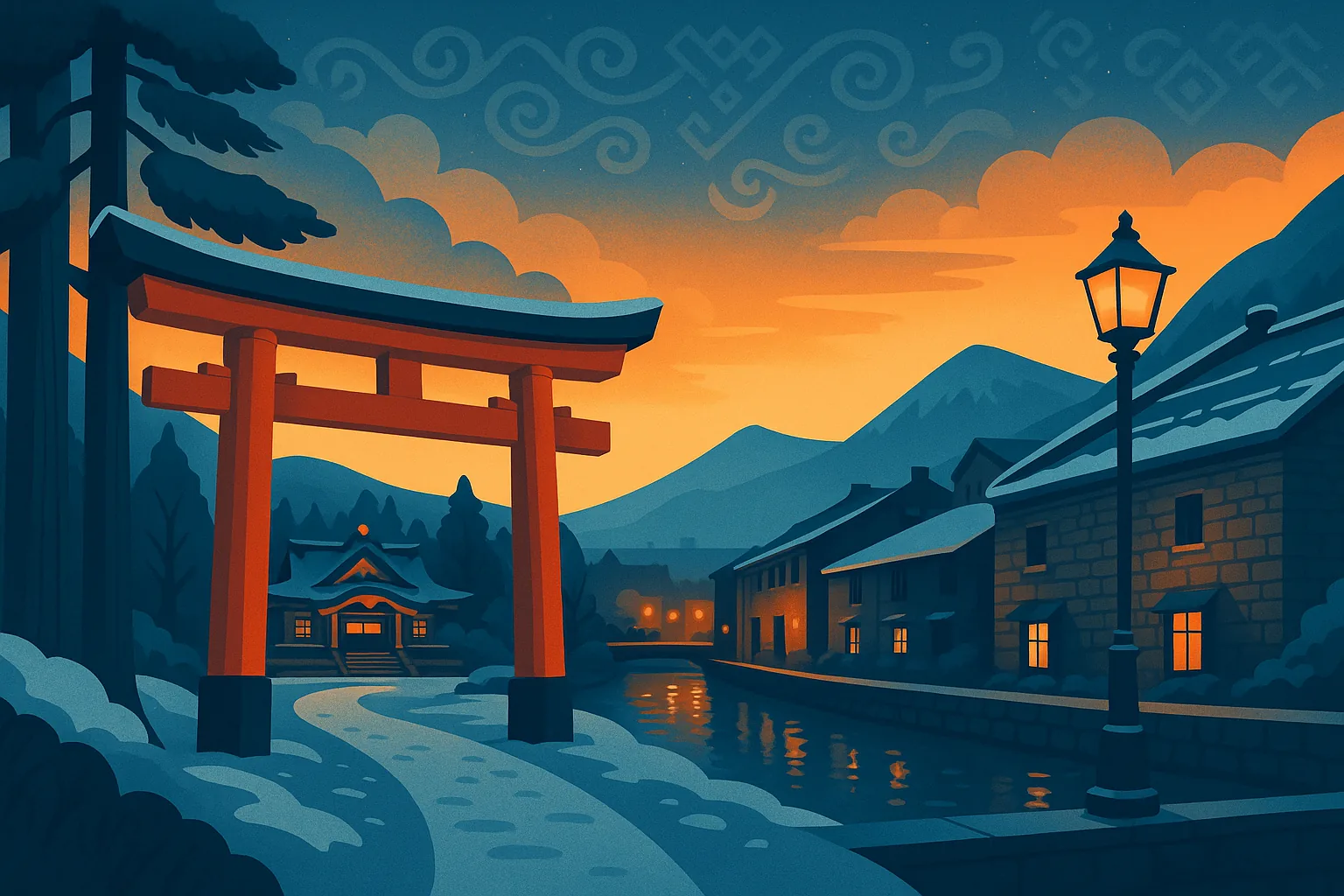

Hokkaido Cultural Itinerary
← Back to Cultural Itineraries
Hokkaido cultural itinerary (modular) stacks culture-first days from Sapporo with calm pacing. Start with shrine and museum layers in the city, then add Otaru canal crafts and an Ainu heritage day at Upopoy in Shiraoi—while minimizing long transfers.
Quick Facts
- Base: Sapporo (day trips: Otaru / Shiraoi)
- Pace: Medium (3 blocks/day; 1 pre-booked activity/day)
- Moves: JR day trips; no hotel change required
- Best Seasons: May–Oct (winter needs snow/ice buffer)
- Passes: IC in Sapporo; reserve JR seats in peak seasons
- Budget tier: ¥¥ (see Budget)
- Map: See Access & Map
- Accessibility: See Accessibility & Family
Contents
What makes Hokkaido different?
Hokkaido is where nature and seasonality shape everyday life and culture. Unlike much of Japan, Hokkaido developed later as a frontier region, where communities adapted to vast landscapes, harsh winters, and a close relationship with the natural environment.
What you experience here is not historical formality, but a lifestyle shaped by the seasons — from fresh seafood and dairy culture to open landscapes, national parks, and the rhythm of snow, harvest, and changing light.
If Kyoto feels refined and Kanazawa feels preserved, Hokkaido feels expansive and elemental — a place where culture is not structured by tradition, but shaped by nature itself.
How to Use
Start at Day 1 and take the first N days. Reorder for closures or weather. Book workshops and Upopoy timed entry in advance.
Itinerary
→ Accessibility information for these days
-
Day 1 — Sapporo: Shrine, museum cluster & seasonal city walk
Morning
Hokkaido Jingu via Maruyama Park; quiet paths and ritual spaces.
Afternoon
City museums (Historical Village area or art spaces) and a tea pause.
Evening
Odori stroll; view spots; relaxed dinner with local produce.
Cultural connection: settlement history, shrine etiquette, and modern city layers.
-
Day 2 — Otaru: Canal heritage & crafts
Morning
Canal and stone warehouses; glass & music-box traditions overview.
Afternoon
Studios/galleries; optional short demo or tasting on Sakaimachi Street.
Evening
Canal lights at dusk; return to Sapporo.
Cultural connection: merchant culture and craft revival along the canal.
-
Day 3 — Shiraoi: Upopoy (National Ainu Museum & Park)
Morning
JR to Shiraoi; Upopoy museum galleries (timed entry recommended).
Afternoon
Kotan area and cultural performances if available.
Evening
Return to Sapporo; simple local dinner.
Cultural connection: Ainu language, craft and performing traditions in context.
Traditional & Local Foods
Hokkaido’s food culture reflects its cold climate, surrounding seas, frontier history, and strong relationship with seasonal abundance. This section focuses on foods with cultural meaning rather than sightseeing-oriented gourmet picks.
Quick taste summary: Hokkaido flavors often feel clear, generous, and ingredient-driven rather than delicate in a Kyoto-style way. Many local dishes highlight freshness, natural sweetness, richness from dairy, and the clean taste of seafood from colder waters.
Core Cultural Foods
- Seafood from northern waters: crab, salmon, scallops, uni, and other seafood are central to Hokkaido’s identity. Taste-wise, freshness and sweetness stand out, with flavors that often feel clean, rich, and naturally full rather than heavily seasoned.
- Dairy culture: milk, butter, cream, and cheese reflect Hokkaido’s large-scale farming and cooler climate. Taste-wise, many dairy products feel rich and smooth, often with a fresher and cleaner finish than expected.
- Soup curry: a modern Sapporo specialty that has become part of the region’s food culture. Taste-wise, it is lighter and more aromatic than thick curry, with spiced broth and vegetables that keep their individual character.
Secondary Local Specialties
- Jingisukan: grilled lamb strongly associated with Hokkaido dining culture. Taste-wise, it is savory and satisfying, often slightly richer in aroma than standard Japanese meats, but balanced with vegetables.
- Ishikari nabe: a salmon hot pot connected to river and coastal food traditions. Taste-wise, it is warming, miso-based, and gently hearty rather than aggressively heavy.
- Ainu-inspired foods and ingredients: depending on the setting, this may include dishes or ingredients introduced through museum or heritage contexts. Taste-wise, these experiences often emphasize natural materials, local plants, and traditional relationships to the land rather than restaurant-style richness.
Traditional Drinks
- Local milk and dairy drinks: Hokkaido is strongly associated with high-quality milk culture. Taste-wise, they are often rich and creamy, yet still feel clean and fresh.
- Hokkaido sake and local craft beverages: colder climates and regional ingredients support a distinct drinking culture. Taste-wise, profiles vary, but many feel crisp and easy to pair with seafood and lighter regional dishes.
If this may suit your taste: Hokkaido may be a good match if you enjoy fresh seafood, natural sweetness, warming dishes, dairy richness, and food that feels closely tied to climate and landscape. It may feel less ideal if you mainly want highly formal kaiseki-style refinement or strongly sauce-driven flavors.
Best fit within this itinerary: Day 1 pairs naturally with local produce, dairy sweets, or soup curry in Sapporo; Day 2 suits seafood and sweets in Otaru after canal and craft walks; Day 3 works well for a simpler meal that connects to Ainu heritage or regional ingredients after Upopoy, before returning to Sapporo.
Seasonal & Rainy Swaps
- Rain / Snow: Use museum clusters and covered passages; shorten outdoor loops.
- Summer: Early/late outdoor walks; interiors at midday.
- Winter: Add transport buffer; prefer core routes with reliable snow clearance.
Etiquette
- Shrines/temples: keep to the side of the main approach; follow posted photo rules.
- Museums/performances: arrive early; phones silent; no flash where restricted.
- Snow/ice days: move slowly; use handrails; mind wet floors at entrances.
Handy Phrases in Japanese (Romaji)
- Excuse me: Sumimasen
- Thank you: Arigatō gozaimasu
- Two tickets, please: Kippu o nimai onegai shimasu
- May I take photos?: Shashin o totte mo ii desu ka?
- Where is …?: … wa doko desu ka?
Accessibility
- Upopoy (National Ainu Museum & Park): Visitors with Disabilities (official)
- JR Hokkaido: Accessibility Guide (PDF)
- New Chitose Airport: Barrier-Free Services
- Sapporo: Barrier-Free Sightseeing Spots / City Map (PDF)
- Otaru: Otaru Digital Map
- Hokkaido Jingu: Official site (EN)
Note: Accessibility offerings can change. Check the official pages above before you go.
Access & Map
- From Tokyo: Tokaidō Shinkansen to Nagoya → JR Ltd. Exp. “Hida” to Takayama; or Hokuriku Shinkansen to Toyama → JR to Takayama.
- From Kyoto/Osaka: Shinkansen to Nagoya → JR “Hida” to Takayama.
- From Kanazawa/Toyama: Hokuriku Shinkansen to Toyama → JR to Takayama.
- Airports: Chubu Centrair (NGO) for Nagoya connection; Komatsu (KMQ) / Toyama (TOY) for Hokuriku side.
- Getting around: Old Town is walkable; local buses reach Hida Folk Village and other sites; taxis useful for short hops.
- Pass / IC: Suica/PASMO/ICOCA work on JR gates; bus IC acceptance varies—carry small cash just in case.
- Accessibility: Takayama Station has elevators; some heritage streets have slopes/cobbles—allow extra time.
Takayama Station Hida-Furukawa Station Sanmachi (Old Town) Takayama Jinya Hida Folk Village Miyagawa Morning Market Shirakawa-go (Ogimachi)
Budget
| Item | ¥ Range | Notes |
|---|---|---|
| Transport (within Takayama) | ¥500–¥1,200 | Walk for Old Town; local buses/taxis for Hida Folk Village and outlying sights. |
| Admission | ¥0–¥1,500 | Many streets free; typical sites (Jinya/Folk Village/museums) modest fees. |
| Food / Tea | ¥2,000–¥4,000 | Casual lunch + café/snack; dinner depends on choice (try Hida beef specialties). |
| Optional | ¥0–¥4,000 | Workshops, extra exhibits, short taxi segments; day-trip buses priced separately. |
| Total (per person / day) | ¥5,000–¥11,000 | Tier: ¥¥ (standard) |
¥ = frugal (<¥5,000) · ¥¥ = standard (¥5,000–¥12,000) · ¥¥¥ = comfort (>¥12,000)
*Intercity rail (Nagoya/Toyama/Kanazawa ↔ Takayama) and airport transfers are extra; seasonal events may affect prices.
EXPLORE
Popular next itineraries and Japanese culture
Choose your next route by interest: start with well-known cities, go deeper culturally, or explore from a different angle.
Start with well-known cities
Go deeper culturally
Try a different perspective
Planning a trip? Use the Trip Planner to turn these ideas into a culture-first itinerary.