
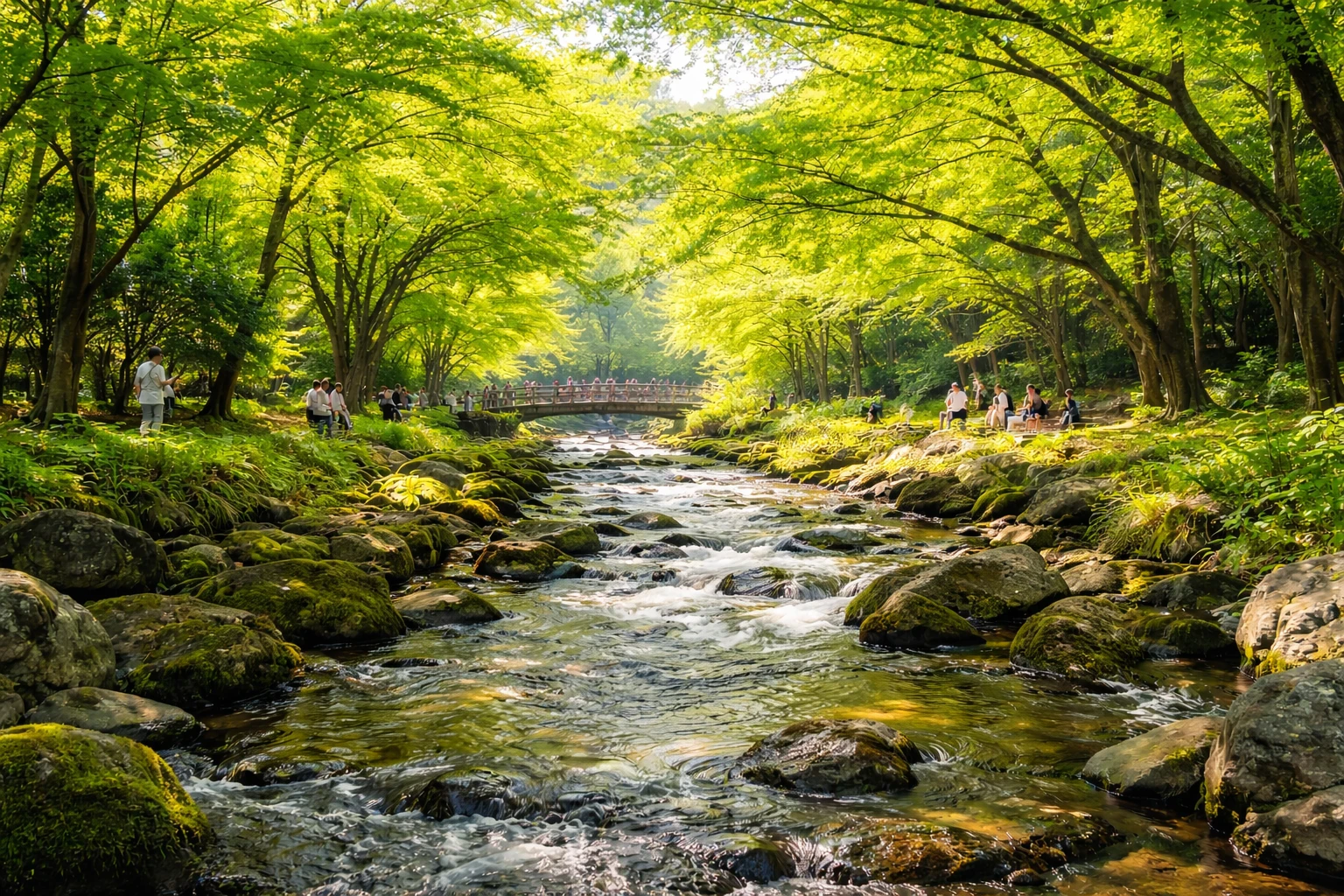

Greenery Day in Japan
Greenery Day in Japan is a national holiday celebrated on May 4 during Golden Week. It is a day to appreciate nature and reflect on the relationship between people and the natural world.
Contents
What is Greenery Day?
Greenery Day, or Midori no Hi, is a national holiday in Japan observed on May 4 as part of Golden Week. The official purpose of the day is to appreciate nature and express gratitude for its blessings.
While the definition is simple, the day reflects a broader idea in Japanese culture, where nature is not seen as separate from daily life but as something people live alongside.
Why does this day exist?
Greenery Day is historically connected to Emperor Showa, who had a strong interest in biology and the natural world. After his passing in 1989, April 29—his birthday—was renamed Greenery Day.
In 2007, the holiday was moved to May 4, while April 29 became Showa Day. This change reflects how Japan often preserves important dates while gradually redefining their meaning.
Today, Greenery Day emphasizes appreciation of nature rather than focusing on a specific individual.
How is it experienced today?
Greenery Day does not have widely defined customs or major national events. Officially, it is a day to appreciate nature, but how people interpret that idea varies.
In practice, the day is often experienced in a calm and relaxed way. During Golden Week, which is typically busy and travel-heavy, Greenery Day can feel like a quieter moment within that period.
This atmosphere is not formally prescribed, but it reflects how people naturally engage with the idea of appreciating nature in everyday life.
Japan’s relationship with nature
The meaning of Greenery Day becomes clearer when viewed in a broader cultural context. In Japan, nature is not usually treated as something to control or escape from, but as something to live with in balance.
This perspective appears in many aspects of life—from seasonal foods and traditional crafts to gardens and living spaces. Rather than separating people from nature, Japanese culture often emphasizes coexistence.
Greenery Day can be seen as a modern expression of this long-standing relationship.
How people spend it today
Many people spend the day outdoors or in ways that bring them closer to nature, although there is no fixed way to observe it.
- Walking in parks or along rivers
- Visiting gardens or natural areas
- Spending time outside without a specific plan
The day is often less about activities and more about awareness of the surrounding environment.
Travel tips for visitors
If you are visiting Japan during Golden Week, Greenery Day offers a different atmosphere compared to more crowded or event-focused holidays.
- Visit parks and gardens for a more relaxed experience
- Start early to avoid peak travel times
- Explore smaller local green spaces as well as well-known locations
Even in urban areas, you may notice seasonal greenery more clearly on this day.
Trivia
- Greenery Day was originally celebrated on April 29 before being moved to May 4 in 2007.
- It is one of several Japanese holidays connected to nature and the seasons.
- The term “greenery” often reflects a broader awareness of seasonal change, not just plants themselves.
FAQ
Q. What is Greenery Day in Japan?
A. It is a national holiday on May 4 that encourages appreciation of nature.
Q. Is Greenery Day part of Golden Week?
A. Yes. It is one of the holidays within Golden Week.
Q. Are there special events?
A. There are no major nationwide events, and the day is generally observed in a flexible and personal way.