
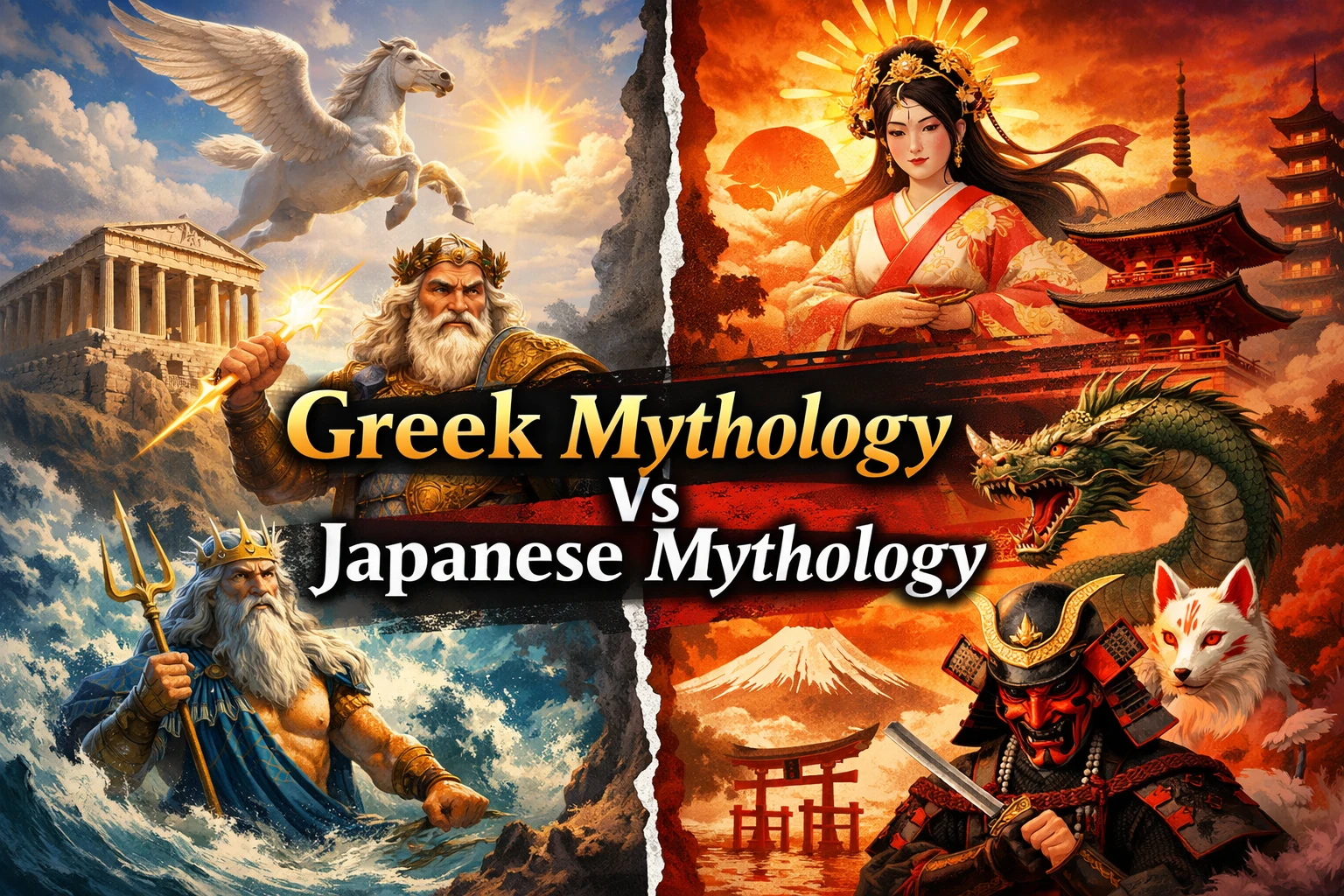

Comparative Culture Guide: Greek mythology vs Japanese mythology
Understanding East–West Differences Through Mythology
In many Western countries, children grow up studying Greek mythology as a foundation of “Western civilization.” In Japan and across Asia, however, people inherit different myth traditions—often rooted in nature, harmony, cosmic order, or rebirth. By comparing them in a simple way, you can spot the “default assumptions” each culture uses to explain life, nature, and what it means to be human.
Quick Summary
This guide compares Greek mythology with Japanese and other Asian myth traditions to show how cultures build different worldviews: heroic conflict vs. restoring balance, moral failure vs. impurity, and linear stories vs. cyclical time. Use it as a cultural lens—not a strict rulebook—because every region has exceptions and blended histories.
Quick comparison at a glance
In the West: Greek mythology as basic education
- Core part of literature, philosophy, art, and history education
- Many English words come from Greek myths (chaos, muse, narcissism, panic)
- Shapes Western ideas of heroes, morality, and dramatic storytelling
- Often taught as cultural “roots” across Europe and North America
In the East: several different myth worlds
- Japan: Shinto mythology, many kami, nature and purification
- China: creation myths and cosmic order (yin-yang, five elements)
- India: vast pantheon, karma, rebirth, epic stories
- Korea & SE Asia: ancestry myths, mountains, spirits, layered traditions
Why this comparison helps cultural understanding
Comparing mythologies is useful because myths act like a culture’s “default settings”: what counts as order vs. chaos, how humans relate to nature, and what a “good life” looks like. Once you notice those patterns, shrines, festivals, historical sites, and even pop culture references become much easier to interpret.
- Travel reading: place-based kami and shrine stories become “legible,” not just decorative.
- Value differences: conflict/heroism vs. balance/purification shows up in customs and etiquette.
- Time & renewal: cyclical rituals explain why seasonal repetition matters in Japan and parts of Asia.
- Avoid stereotypes: use these as tendencies; real life is blended and regional.
Why Western countries study Greek mythology
In many Western countries, especially in Europe and North America, Greek mythology is treated as a kind of cultural “starting point.” Students often meet these stories in school as part of their basic education.
Greek myths support several pillars of Western culture:
- Literature: epics like the Iliad and Odyssey, classical drama, poetry
- Philosophy & thought: the ancient Greek world around Plato and Aristotle
- Art & architecture: statues, temples, symbols based on gods and heroes
- Politics & law: ideas about city-states, citizenship, and justice
English and other European languages also contain many words that come from Greek myths: chaos, muse, narcissism, atlas, panic, and more. Modern stories—from Shakespeare to Hollywood heroes—still use Greek-style patterns: a single hero, trials, moral choices, and dramatic gods who interfere in human life.
In short, for the West, Greek mythology is not just “one set of stories.” It is a shared reference point that helps explain where many ideas about heroes, morality, drama, and classical culture came from.
Japanese mythology: kami, nature, and purification
Japanese mythology is mainly recorded in two early texts, the Kojiki and the Nihon Shoki, compiled at the imperial court in the 8th century. These books describe how the islands of Japan were formed, how countless kami appeared, and how the imperial line connects to key deities.
Here, kami is written with a small “k” because it is a common noun (a type of sacred being), not a single absolute God. Kami can be found in mountains, rivers, winds, unusual rocks, ancient trees, communities, or respected ancestors. Instead of one all-powerful creator, Japanese mythology assumes an abundance of sacred presences.
A few core themes in Japanese mythology include:
- Creation by a divine couple: Izanagi and Izanami stirring the sea and forming islands
- Birth of kami: deities of fire, water, wind, mountains, and more
- Impurity and cleansing: contact with death creates impurity, removed through purification
- Light and harmony: Amaterasu, the sun kami, hiding in a cave and returning through a joyful ritual
Time in Japanese mythology often feels more cyclical than linear. Seasons return, rituals of cleansing repeat, and festivals are held again and again. The goal is not to defeat an eternal enemy, but to restore balance when it is disturbed. This way of thinking still influences customs today, from shrine visits and New Year rituals to everyday ideas about cleanliness and social harmony.
How other Asian mythologies look
While Greek mythology can act as a single reference point for much of the West, Asia includes several major mythological traditions. Each developed in its own environment and history.
Chinese mythology: cosmic order and balance
In Chinese mythology, many stories describe the structure of the universe and the balance of forces. Creation myths such as Pangu dividing heaven and earth, or Nüwa shaping humans, sit alongside concepts like yin-yang and the five elements. Gods and legendary figures often embody cosmic principles rather than only personal drama.
Indian mythology: karma, rebirth, and epic scale
Indian mythology, especially within the Hindu tradition, is one of the most extensive in the world. Deities such as Brahma, Vishnu, and Shiva appear in many forms, and epic stories like the Mahabharata and Ramayana explore duty, karma, and rebirth. Here, the mythic world is deeply connected to ideas of moral cause and effect across many lifetimes.
Korean mythology: ancestry and sacred mountains
Korea’s well-known Dangun myth tells of a heavenly being descending, a bear transformed into a woman, and the birth of Dangun, the founder of the Korean people. Mountains and ancestral spirits play a strong role, echoing themes of sacred landscape similar to Japan.
Southeast Asian traditions: blended worlds
In parts of Southeast Asia, local spirit beliefs combine with imported Hindu and Buddhist stories. Thai versions of the Ramayana, local guardian spirits, and Buddhist cosmology often coexist. The result is a layered mythic world where village spirits may live alongside figures from large epic tales.
West vs East: core differences in worldview
Comparing Greek mythology with Japanese and other Asian mythologies is not about deciding which is “better.” Instead, it shows how different cultures answer similar questions in different ways.
Personality vs presence
In Greek mythology, the gods are strong personalities. Zeus, Athena, Apollo, and others have clear emotions, alliances, and conflicts. Their stories are full of jealousy, love, revenge, and clever plans.
In Japanese mythology, kami often feel more like presences than characters. Some major kami, like Amaterasu or Susanoo, have strong personalities, but many others are simply the kami of a mountain, a river, or a shrine—important because of place and relationship, not only personal drama.
Conflict vs harmony
Greek myths often center on conflict: gods fighting, heroes being tested, and moral choices bringing reward or punishment. They are powerful stories about individual struggle.
Japanese myths often focus on restoring harmony after something goes wrong. When impurity spreads, it is cleansed. When light disappears, it is invited back through a joyful ritual. The emphasis is less on defeating an enemy and more on re-balancing the world.
Sin vs impurity (and karma as another frame)
In Greek and later Western traditions, wrongdoing is often framed as moral failure that deserves consequences. Heroes may pay for arrogance or cruelty.
In Japanese mythology, the focus is more on impurity or pollution: something that disturbs the relationship between people, kami, and the natural world. The solution is to purify and reset, rather than judge forever. In other Asian traditions, ideas of karma and rebirth add another layer: actions shape future experiences over time.
Linear vs cyclical time
Greek myths often follow a linear path: a hero is born, grows, faces trials, and dies. There is a clear before and after.
Many Asian mythologies, including Japanese, feel more cyclical. Seasons return, festivals repeat, and purification is never “finished” once and for all. Time is felt as recurring cycles rather than a straight line.
Nature as stage vs nature as sacred presence
In Greek myths, nature is often the stage for gods and heroes. Mountains or seas appear, but the focus is usually on the actions of deities and humans who move through them.
In Japanese and many other Asian traditions, nature itself can be sacred. A forest, a waterfall, or a particular rock may become the center of reverence. This difference still affects how people think about landscape, development, and what it means to respect a place.
Note: these are broad tendencies. Greek tradition also includes local spirits and sacred landscapes, and Japan also has dramatic conflicts and heroic episodes. The value of comparison is noticing emphasis, not creating stereotypes.
Why people like to compare mythologies
People often enjoy comparing Greek mythology with Japanese and Asian mythologies because similarities and differences reveal hidden assumptions. What felt “normal” inside one culture becomes visible when placed next to another.
For Western readers, Japanese myths show a world where harmony, cycles, and sacred places matter deeply. For Japanese or Asian readers, Greek myths highlight a world of dramatic personalities, sharp conflict, and heroic tests. The act of comparison itself becomes a gentle cultural mirror.
In that sense, comparing myths is not just academic. It is a way of practicing cross-cultural understanding—and of seeing our own background more clearly.
Trivia: small details that reveal big patterns
- In Japanese, kami is a common noun, so it is often written with a lowercase “k” in English. It can mean many sacred presences rather than one absolute being.
- Greek gods often behave more emotionally than modern readers expect from divine beings, which makes them feel surprisingly human even though they are immortal.
- Some Asian traditions—especially in India—feature deities who appear in many forms or incarnations, reflecting complex ideas of time, rebirth, and cosmic cycles.
- Korea’s Dangun myth and Japan’s myths of imperial descent both connect political authority to divine origins, but through very different narrative styles.
- Modern anime, manga, and films often borrow from both Greek and Japanese mythologies, mixing names, symbols, and story patterns in creative ways.
FAQ: quick answers for beginners
Do all Western countries study Greek mythology?
Not every student reads the same texts everywhere, but in many European and North American systems, Greek mythology is widely taught or referenced in general education. It appears in literature, history, art, and cultural studies because it is seen as part of Western cultural heritage.
Are kami the same as Greek gods?
Not exactly. Kami are often better understood as sacred presences or powers—frequently linked to places and natural phenomena. Some major kami act like story deities, but many are local guardians. Greek gods, by contrast, are strongly personified and appear in many stories focused on actions, emotions, and conflicts.
Is one mythology “more advanced” than another?
No. Each mythology reflects the environment, history, and needs of the culture that shaped it. Greek myths are not “better” than Japanese, and Japanese myths are not “more spiritual” by default. They are different maps for interpreting life and the world.
Can mythology still influence modern life?
Yes. Even when people do not take every story literally, myths live on in festivals, language, art, architecture, place identity, and everyday customs. Visiting shrines in Japan or ancient sites connected to Greek religion are ways of walking through older story worlds.
Sources & reference resources
For readers who want to explore mythology and religion through official, museum, or public/academic sources, these links can be helpful starting points. (Each site has its own depth and audience.)
- Japan National Tourism Organization – Culture & Traditions Overview
- Kids Web Japan – Religion in Japan (simple explanation of kami & Shinto)
- Jinja Honchō – What is Shinto? (Shrine Association overview)
- Acropolis Museum – Exhibitions related to ancient Greek religion and myth
- British Museum – Greek and Roman World (objects connected to Greek mythology)
- National Diet Library of Japan – Digital collections and research navigation
Tip: for travel use, local shrine/temple pages and city museums often provide short origin stories that connect a place to a deity, legend, or seasonal ritual—perfect for “reading” mythology on the ground.