

Quick Summary
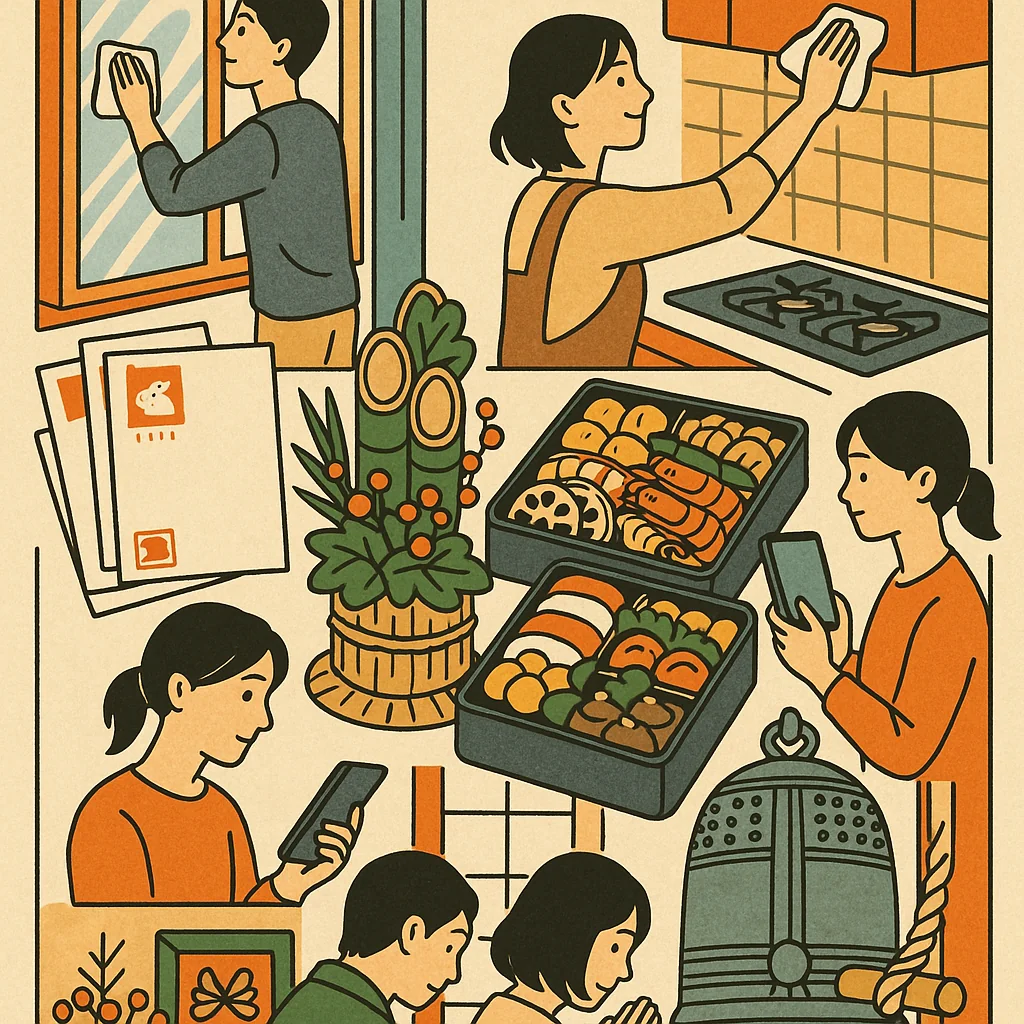
In Japan, the year-end season is more than a countdown to New Year’s Eve. It is a cultural “reset period” when people clean their homes, organise belongings, close off relationships and prepare to welcome Toshigami-sama, the New Year deity. From ōsōji (deep cleaning) to year-end greetings and quiet family time, December blends busyness and stillness in a uniquely Japanese way. In today’s Japan, many of these customs survive in a lighter, more flexible form: people spread cleaning over weekends, order osechi online and send more digital greetings than paper cards.
Year-end in Japan at a glance
For many people in Japan, December is not only about parties and sales. It is a month of closing open loops: finishing work, saying thank you to colleagues, tidying spaces and preparing the home for the New Year.
There is a strong idea of starting January 1st “as clean as possible”. At the same time, contemporary life has changed how people handle this season. Long working hours, small apartments and online services mean that many families now combine traditional ideas with modern conveniences.
Typical year-end themes in today’s Japan include:
- Doing some form of house cleaning (large or small)
- Sorting belongings, paperwork and digital data
- Sending year-end greetings by postcard or message apps
- Ordering osechi and New Year food rather than cooking everything
- Joining smaller, quieter year-end gatherings instead of big parties
- Spending a relaxed New Year’s Eve with family, TV or at a temple or shrine
The cultural meaning of ōsōji
Ōsōji (大掃除) literally means “big cleaning”. On the surface it looks like just a deep-clean of the house, but the idea comes from older religious and seasonal practices. Even though many people today only do a lighter version, the symbolic meaning is still widely recognised.
From “susuharai” to modern ōsōji
In temples and shrines, there is a custom called susuharai (煤払い), usually held around 13 December. Priests and monks sweep away dust and soot from beams and halls to purify the space before welcoming the New Year. This idea of “sweeping away the old year’s dust” later spread to ordinary homes. Today, people might not know the exact date or details of susuharai, but the image of “year-end cleaning” remains strong.
Welcoming Toshigami-sama
In traditional belief, the New Year deity Toshigami-sama visits each household at New Year. People clean their entrance, tokonoma alcove and living spaces so the deity can be welcomed into a fresh and respectful environment. Many modern families may not consciously think of Toshigami-sama, yet they still feel that a clean entrance and living room are important for New Year.
Cleaning as removing “kegare”
In Shinto, kegare (穢れ) can mean dirt, but also tiredness, bad mood and the heaviness that builds up through the year. Ōsōji is a way to remove this build-up, both physically and emotionally. In the 2020s this idea often appears in lifestyle magazines and social media as “resetting your space and mind” at the end of the year.
What people actually do in December
1) House cleaning and organising
Many households still try to clean more thoroughly in December, even if they no longer do a perfect “top-to-bottom” ōsōji. Typical spots include:
- Entrance, genkan and shoe area
- Windows, window frames and screens
- Kitchen: stove, extractor fan, sink area
- Bathroom, toilet and laundry area
- Balcony or small garden
In modern life, it is common to spread cleaning over several weekends, or to focus on just a few symbolic places such as the entrance and kitchen. Cleaning companies also offer year-end packages, so some people now outsource the hardest parts like the bathroom or extractor fan.
2) Decluttering and paperwork
Year-end is also a chance to deal with accumulated things: leaflets, old bills, unused clothes and forgotten items. Some people also do a “digital ōsōji” by sorting photos, emails and files. In recent years, books and TV shows about minimalism and storage techniques have made this kind of year-end decluttering even more popular.
3) Modern-style New Year cards (nengajō)
Traditionally, people send nengajō (New Year postcards) that arrive on 1 January. Younger generations now rely more on messaging apps and social media, but the habit of sending some kind of New Year greeting is still very common.
Many people order printed cards online, use smartphone apps to design photo cards or send digital cards instead of handwriting every message. Office workers may send fewer cards than before, while families with children and older relatives often continue the postcard style.
4) Preparing for osechi ryōri (New Year food)
Osechi ryōri is the traditional New Year meal packed in layered boxes. Each dish carries a wish—good health, prosperity, long life or family safety. In modern Japan, many households no longer make everything from scratch.
Instead, people can:
- Order ready-made osechi from department stores or hotels
- Reserve osechi sets at supermarkets and convenience stores
- Buy a few symbolic dishes and combine them with everyday food
This mix of tradition and convenience allows busy families and small households to keep the New Year feeling without spending days in the kitchen.
5) Bōnenkai (year-end parties)
Bōnenkai (忘年会) literally means “forget-the-year party”. Colleagues or friends gather to share food and drinks and symbolically leave the year’s hard work and stress behind.
In recent years, large, late-night office parties have become less common. Companies often choose smaller, shorter gatherings, or replace one big party with casual lunches and team-level meetups. Some groups also enjoy “home bōnenkai” or online gatherings instead of going out.
6) Ōmisoka – New Year’s Eve
New Year’s Eve is called Ōmisoka (大晦日). Many people:
- Eat toshikoshi soba, long buckwheat noodles symbolising long life
- Watch TV programmes such as music shows or comedy specials
- Visit a temple to hear the joya no kane (New Year’s Eve bell)
- Spend a quiet night at home and visit a shrine after midnight or early on 1 January
While some young people go to countdown events or theme parks, the overall atmosphere of Japanese New Year’s Eve is still relatively calm compared to big-city fireworks in other countries.
How to try Japanese-style year-end cleaning
You do not need a huge house or a full free day to experience ōsōji. Here is a simple version you can try anywhere in the world, inspired by how many people in Japan now adapt the tradition to busy lives.
Step 1: Choose just one or two key areas
Pick the spaces that feel most symbolic for you: the entrance, kitchen counter, desk or bedroom. Focusing on a few places gives a stronger sense of “reset” than trying to clean everything.
Step 2: Remove what you no longer need
Before wiping surfaces, take a few minutes to remove trash, expired items and things you clearly no longer use. Put “maybe” items in a box for later, so the decision does not slow you down.
Step 3: Clean from high to low
Just like temple susuharai, start from shelves and upper surfaces, then move downwards. Dust and small dirt will naturally fall and be caught in the final floor cleaning.
Step 4: Refresh the entrance
In Japanese culture the entrance is where luck and guests come in. Wipe the door, sweep or vacuum, and if you like, add a small seasonal decoration, flowers or even a simple paper ornament. This echoes the way many households in Japan still focus on the entrance even if they skip a full ōsōji.
Step 5: Do a mini “digital ōsōji”
Spend 15–30 minutes deleting unused apps, old screenshots and duplicate photos. Create one folder for “This year’s memories” so that your devices feel lighter for the new year too. Digital cleaning has quietly become part of modern Japanese year-end routines.
Step 6: Take a moment of reflection
After cleaning, make tea or your favourite drink, sit in the refreshed space and quietly review your year: what made you happy, what was difficult, and what you want to bring into the next year. This gentle pause is as important as the physical cleaning itself.
Travel tips for spending year-end in Japan
- Expect crowds in supermarkets and department stores in the last few days of December, when people buy New Year food and decorations.
- Some museums and attractions close around 29 December–3 January, so check opening dates in advance.
- Many temples hold susuharai or cleaning events in mid-December. Some are open to visitors as quiet, photogenic scenes.
- On Ōmisoka, you may hear joya no kane (temple bells) just before and after midnight. Some temples allow visitors to ring the bell, usually with a small fee or reservation.
- Public transport runs but can be crowded on New Year’s Eve and during the first shrine visits (hatsumōde). Give yourself extra time when moving around major cities.
Trivia
- The traditional date for temple and shrine susuharai is 13 December, which used to mark the start of formal New Year preparations.
- The idea of eating toshikoshi soba became popular in Edo (Tokyo) from the 18th century. The long, easy-to-cut noodles symbolise cutting off misfortune from the old year.
- Kagami-mochi’s round shape is said to represent both the sun and the soul, and the stacked form can be read as past year + coming year together.
- Many Japanese people casually say they will “do ōsōji”, but in reality surveys show that a full house deep-clean is rare; most people focus on just a few important areas or use cleaning services.
- Convenience stores and supermarkets now compete with department stores by offering affordable osechi sets, making it easier for single-person households and young couples to enjoy a small New Year box.
FAQ
When do people in Japan usually do ōsōji?
Traditionally, year-end cleaning starts after 13 December, following the susuharai custom. Today many people break it into small tasks throughout December, or use weekends before New Year. Some also book professional cleaners for kitchens and bathrooms.
Is there a “bad day” to put up New Year decorations?
Some people avoid 29 December because the number “29” can be read as “double suffering” in Japanese wordplay. 31 December can also feel “last minute”. Many families decorate between 26 and 28 December instead.
Can visitors join year-end or New Year’s Eve events?
Yes. Many temples and shrines welcome visitors on Ōmisoka and during the first shrine visits (hatsumōde). Just follow local etiquette: be quiet in line, avoid pushing, and keep phones on silent mode.
Do all Japanese people still send nengajō postcards?
The number of paper postcards is decreasing, especially among younger generations, but the habit of sending New Year greetings by some method is still very common. Many people now combine a small number of physical cards with digital messages.
External resources
- Japanese government and tourism information on Japan National Tourism Organization (JNTO)
- Background on New Year customs from Jinja Honchō (Association of Shinto Shrines)
- Articles and archives on Japanese annual events at National Diet Library of Japan
Japanese year-end traditions